BTS’s Decision For This Year’s Grammy Awards Sparks Massive Response
Article Editorial Team

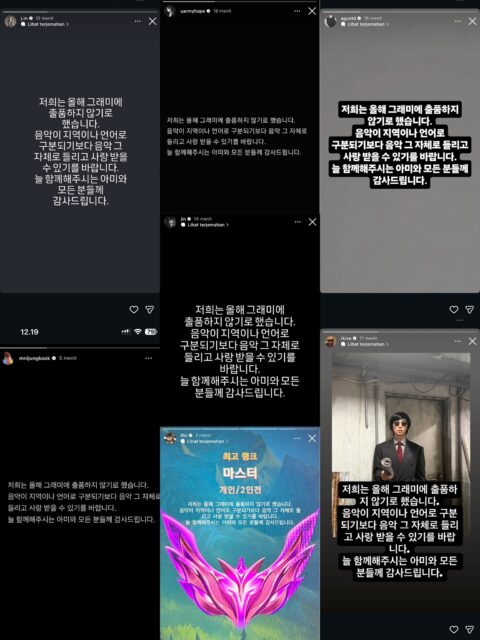
Global music sensation BTS announced on July 29, 2026, that they would not be submitting any entries for consideration at this year’s Grammy Awards, a decision that has sent ripples across the international music industry and sparked an overwhelming show of support from their dedicated fanbase, ARMY. The seven members—RM, Jin, Suga, J-Hope, Jimin, V, and Jungkook—each posted a synchronized statement on their personal Instagram accounts, collectively conveying a powerful message that transcends mere awards recognition.
The announcement, which quickly went viral, featured a concise yet profound statement: "We have decided not to submit an entry for this year’s Grammys. Rather than categorizing music by region or language, we hope music itself can be heard and loved for what it is. We sincerely thank ARMY and everyone who is always with us." This declaration, made just minutes after its release, instantly became a focal point of discussion, interpreted by many as a direct commentary on the Recording Academy’s approach to global music and its recent introduction of new, regionally specific award categories.
The Announcement Heard Around the World
The carefully coordinated release across individual member accounts underscored the group’s unified stance on the matter. Each post featured the same message, presented in both Korean and English, ensuring its reach to their vast global audience. This strategic dissemination amplified the impact, allowing the news to quickly dominate social media trends and news cycles worldwide. The timing of the announcement, coinciding with the period when artists typically begin submitting their work for Grammy consideration, further highlighted its deliberate and impactful nature. The message itself, advocating for music to be appreciated intrinsically, irrespective of its origin or linguistic classification, resonated deeply with fans and critics who have long observed the challenges faced by non-Western artists in gaining mainstream recognition at prestigious American awards ceremonies.

A History of Complex Relations: BTS and the Grammys
BTS’s journey with the Grammy Awards has been a multifaceted one, characterized by groundbreaking achievements, fervent fan anticipation, and persistent critical debate. Their initial interactions with the Recording Academy began in 2019 when they became the first Korean group to present an award at the ceremony. The following year, they made history again by performing alongside Lil Nas X for a segment of "Old Town Road," marking their debut performance on the Grammy stage. These early appearances were widely celebrated as significant milestones, symbolizing a gradual opening of Western music institutions to K-Pop and global artists.
However, the relationship grew more complex with their subsequent nominations. In 2021, BTS received their first solo Grammy nomination for "Dynamite" in the Best Pop Duo/Group Performance category. Despite the immense global success of the track, which became their first number-one hit on the Billboard Hot 100, they did not win. The following year, their English-language single "Butter" secured another nomination in the same category, again leading to a performance on the Grammy stage, but ultimately, another loss. Their most recent nominations in 2023 included Best Pop Duo/Group Performance for "My Universe" (their collaboration with Coldplay), Best Music Video for "Yet To Come," and a feature on Coldplay’s Album of the Year-nominated Music of the Spheres. Despite these multiple nods, a major category win continued to elude them.
This repeated pattern of nominations, high-profile performances, and subsequent "snubs" fueled a growing narrative among fans and a segment of the music industry that the Grammys were leveraging BTS’s immense global appeal for viewership and relevance without offering commensurate recognition in the major categories. Critics often pointed to the fact that while BTS consistently broke records in sales, streaming, and global chart performance—achieving multiple Billboard Hot 100 number ones, selling out stadiums worldwide, and fostering an unparalleled level of fan engagement—their Grammy recognition remained confined to a single genre-specific category. This led to widespread discussions about the "Grammy bait" phenomenon, where artists are perceived to tailor their music or release English-language tracks specifically to appeal to the Academy, often without the desired outcome. The underlying tension highlighted a perceived disconnect between commercial success and critical validation within the traditional awards framework.
The Catalyst: The "Asian Pop Music Performance" Category

The immediate backdrop to BTS’s momentous decision was the Recording Academy’s recent announcement of a new category: "Best Asian Pop Music Performance." While seemingly an attempt to acknowledge the rising global influence of Asian music, this category was met with considerable skepticism and criticism from various quarters, including many within the K-Pop industry and the wider global music community.
The core concern revolved around the potential for such a category to segregate rather than integrate. Critics argued that creating a specific "Asian Pop" category could inadvertently ghettoize artists from the region, preventing them from competing in broader, more prestigious "general field" categories (Record of the Year, Album of the Year, Song of the Year) or even established genre categories like Best Pop Duo/Group Performance, where BTS had previously been nominated. This approach stands in stark contrast to the Recording Academy’s evolving, albeit imperfect, treatment of other global genres, such as Latin music, where artists like Bad Bunny have successfully competed and been nominated in major categories alongside their wins in dedicated Latin categories.
For BTS, whose message consistently champions unity and universal appeal through music, the creation of a regionally defined "Asian Pop" category likely represented a fundamental disagreement with their artistic philosophy. Their statement, "Rather than categorizing music by region or language, we hope music itself can be heard and loved for what it is," can be directly interpreted as a powerful critique of this new categorization. It underscores their belief that music’s merit should be judged on its own terms, not constrained by geographical or linguistic labels that can reinforce cultural barriers rather than dismantle them. This move by the Grammys, intended perhaps to be inclusive, was instead perceived by many as a step backward, reinforcing the very regional distinctions that BTS has worked tirelessly to transcend.
The Fandom’s Resounding Support: "Knowing Their Worth"
The immediate response from ARMY, BTS’s global fanbase, was one of overwhelming support and affirmation. Social media platforms erupted with messages praising the group for their integrity, courage, and self-respect. Terms like "knowing their worth" and "bigger than the Grammys" quickly trended, encapsulating the sentiment that BTS’s impact and legacy far surpass the validation of any single awards institution.

Fans expressed profound respect for the group’s decision, viewing it as a powerful statement against what they perceived as the Grammys’ historical shortcomings in genuinely recognizing diverse global talent. Tweets flooded in, echoing sentiments such as: "this is the sexiest thing they’ve ever done tbh i’m so glad they know their worth and that they’re bigger than the scammys," from user @theultimatedodo. Another fan, @storyofpjm, articulated, "my love, respect and admiration for bts keeps multiplying and i didn’t even know that was possible. what a statement this is." The collective anger was often directed at the Grammys rather than at BTS, as @KookiesFIower stated, "Honestly it makes me sad and angry but I fing understand them really. And my anger is towards the fass Grammys. They have no clue how to celebrate diversity."
This collective outcry highlighted the deep connection between BTS and their fanbase, where shared values of authenticity and challenging systemic biases are paramount. For years, ARMY has been a vocal advocate for BTS’s rightful recognition, often spearheading campaigns and engaging in detailed analyses of award show criteria. Their sustained engagement has cultivated a powerful sense of solidarity, making this decision feel like a collective stand against perceived injustices in the global music industry. The fans’ response clearly demonstrated that for them, BTS’s artistic integrity and message of universal connection hold more weight than any accolade from a Western establishment.
Broader Industry Perspective and Potential Implications
BTS’s decision carries significant implications for both the Recording Academy and the broader global music landscape. For the Grammys, this move represents a considerable blow to their credibility and perceived relevance in a rapidly globalizing music market. BTS commands one of the largest and most engaged fanbases in the world, and their absence from the submission pool not only deprives the show of potential high-profile nominations and performances but also risks alienating a massive viewership demographic. In an era where traditional awards shows are already struggling with declining viewership and questions about their cultural currency, such a public rejection from a global phenomenon like BTS could further erode trust and legitimacy. It places renewed pressure on the Recording Academy to critically re-evaluate its categorization systems, its definition of "mainstream" music, and its commitment to genuine diversity and inclusion. The debate over how to properly acknowledge and celebrate global music without resorting to tokenism or segregation is now more urgent than ever.
For BTS, this decision solidifies their artistic autonomy and reinforces their status as global cultural leaders who are not beholden to external validation. By choosing to prioritize their artistic philosophy over chasing a prestigious, yet often elusive, Western award, they project an image of unwavering integrity. This move could free them from the pressure of conforming to Western industry expectations, allowing them to focus even more intensely on their creative output, their connection with their fanbase, and their broader philanthropic and cultural diplomacy efforts. It positions them as pioneers who are actively shaping the future of global music recognition, potentially inspiring other non-Western artists to reconsider the value of traditional awards in defining their success.
The ripple effect could extend to other global artists and their respective industries. BTS’s stand might embolden other artists from diverse linguistic and cultural backgrounds to demand true inclusion in major award categories rather than being relegated to specialized "world music" or regional pop categories. It sparks a crucial conversation about the power dynamics within the global music industry and the need for awards institutions to evolve beyond a historically Western-centric viewpoint. The implications suggest a potential shift in how global music success is measured, moving away from a singular focus on Western awards to a more decentralized and culturally sensitive appreciation of artistic merit.
BTS’s Unwavering Global Influence
Even without a Grammy nomination, BTS’s global influence remains unparalleled. Their discography boasts numerous chart-topping hits, record-breaking album sales that often surpass Western counterparts, and sold-out stadium tours across continents. Beyond commercial success, their cultural impact is profound, evidenced by their addresses at the United Nations, their role in promoting South Korean culture globally, and their consistent messaging of self-love, mental health awareness, and social justice. Their connection with ARMY is built on mutual respect and shared values, a bond that has proven to be a more powerful measure of success than any trophy.
Their decision not to submit for the Grammys this year is not an abdication of their artistic excellence but rather a powerful reaffirmation that their worth is intrinsically tied to their art and their profound connection with their millions of fans worldwide, rather than the fluctuating validations of any single institution. It underscores a growing sentiment that true artistic success in the 21st century is defined by global impact, cultural resonance, and authentic connection, rather than by traditional gatekeepers.
In conclusion, BTS’s declaration to forgo Grammy submissions for this year is more than just an announcement; it is a profound statement on artistic integrity, cultural recognition, and the evolving landscape of the global music industry. It challenges established norms, champions universal appreciation for music, and empowers artists to define success on their own terms. As the music world watches, this decision by BTS is poised to leave a lasting legacy, potentially reshaping the dialogue around diversity, inclusion, and the future relevance of major music awards for years to come.
Related News