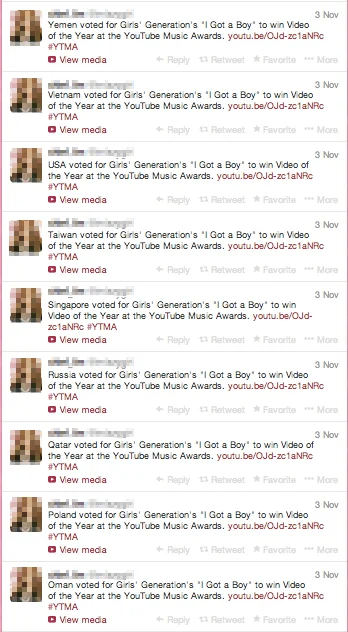
In a historic shift for the digital music landscape, South Korean girl group Girls’ Generation has secured the top honor at the first-ever YouTube Music Awards (YTMA), winning the prestigious Video of the Year award for their 2013 hit "I Got a Boy." Held at Pier 36 in New York City and streamed live to millions of viewers worldwide, the ceremony marked a pivotal moment in the globalization of the Korean Wave, or Hallyu. By surpassing some of the most established names in Western pop music, including Lady Gaga, Justin Bieber, and Miley Cyrus, Girls’ Generation has demonstrated the formidable power of organized digital fandoms and the shifting dynamics of the international music industry.
The victory, announced by presenters Greta Gerwig and Jason Schwartzman, was met with a mixture of celebration and surprise. Tiffany Hwang, a member of the nine-piece ensemble, accepted the award on behalf of the group, expressing gratitude to YouTube and the group’s dedicated fanbase, known as SONEs. The win is particularly significant as it was determined not by a panel of industry insiders, but by the engagement metrics of the global audience, specifically the frequency with which the nominated videos were shared across social media platforms.
The Inaugural YouTube Music Awards: A New Paradigm in Recognition
The 2013 YouTube Music Awards were designed to challenge traditional award shows like the Grammys or the MTV Video Music Awards by focusing entirely on digital consumption and social media interaction. Directed by Spike Jonze and hosted by Schwartzman and Reggie Watts, the event aimed to reflect the actual viewing habits of the internet generation. Unlike other ceremonies that rely on sales figures or radio airplay, the YTMA winners were selected based on data tracking the growth in views, likes, comments, and shares over the preceding year.
For the Video of the Year category, the criteria were specifically narrowed to the "most shared" videos. This metric favored artists with highly active, digitally literate fanbases capable of mobilizing on a global scale. Girls’ Generation’s "I Got a Boy" was nominated alongside a heavy-hitting roster of global superstars, including:
- Miley Cyrus – "We Can’t Stop"
- Justin Bieber (feat. Nicki Minaj) – "Beauty and a Beat"
- Lady Gaga – "Applause"
- One Direction – "Best Song Ever"
- Psy – "Gentleman"
- Macklemore & Ryan Lewis – "Thrift Shop"
- Demi Lovato – "Heart Attack"
- Selena Gomez – "Come & Get It"
- Epic Rap Battles of History – "Barack Obama vs. Mitt Romney"
The inclusion of Girls’ Generation in this list was initially seen by some Western commentators as a niche entry. However, the final result proved that the group’s influence extended far beyond the borders of East Asia, leveraging a sophisticated international network of supporters.
The Mechanics of Digital Fandom: A Systematic Victory
The win for "I Got a Boy" was not a product of chance but the result of a highly coordinated effort by the Girls’ Generation global fanbase. In the weeks leading up to the ceremony, SONEs across various continents organized "voting relays." These sessions were strategically timed to ensure that as one time zone went to sleep, another took over the responsibility of sharing the video link on Twitter, Facebook, and Google+.
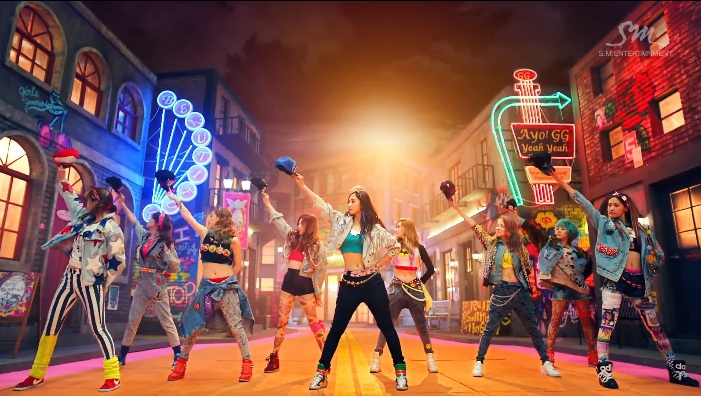
Internal fan communications revealed a sophisticated understanding of the YouTube algorithm. Supporters were encouraged to use unique accounts and diverse IP addresses to maximize the impact of their shares. On social media platforms, the hashtag and link for "I Got a Boy" were disseminated through accounts with names ranging from humorous pseudonyms to regional identifiers, creating a "flood" effect on global trending charts.
This level of organization highlights a broader trend within K-pop culture, where the success of an artist is viewed as a collective achievement for the fans. While Western fandoms for artists like Justin Bieber or One Direction are undeniably massive, the K-pop model emphasizes a "call to action" that is unparalleled in its systematic execution. The YTMA win serves as a case study in how a minority audience, if sufficiently organized, can influence mainstream global outcomes in a democratized digital environment.
Artistic Merit and the "I Got a Boy" Phenomenon
Beyond the statistics of the voting process, "I Got a Boy" represented a significant stylistic departure for Girls’ Generation and K-pop as a whole. Released on January 1, 2013, the track is a maximalist, genre-bending experiment that fuses elements of bubblegum pop, hip-hop, dubstep, and rock. Its unconventional structure—lacking a traditional verse-chorus-verse format—was initially met with mixed reviews from critics but was praised for its boldness and high production value.
The music video itself is a vibrant, fast-paced spectacle featuring intricate choreography and multiple costume changes, designed to capture the attention of a digital audience with a short attention span. The visual complexity of the video played a crucial role in its "shareability." For many international viewers who were introduced to the group through the YTMA nomination, the video served as a high-energy introduction to the polish and professionalism of the South Korean "Idol" system.
Global Reactions and the Cultural Divide
The announcement of Girls’ Generation as the winner triggered a polarized response on social media. In the hours following the ceremony, "Girls’ Generation" and "SNSD" trended globally, but the surge in interest was accompanied by a wave of confusion and, in some instances, xenophobic backlash from fans of the defeated Western nominees. Many users questioned who the group was, frequently using the phrase "Who are they?" to express frustration that their preferred American or British artists had lost to an Asian act.
Conversely, the K-pop community and South Korean media hailed the win as a "national pride" moment. Following the 2012 breakout success of Psy’s "Gangnam Style," there were questions about whether K-pop was a "one-hit wonder" on the global stage. The success of Girls’ Generation at the YTMAs provided a definitive answer, suggesting that the genre’s appeal was not limited to a single viral novelty but was supported by a sustainable and loyal international infrastructure.
Industry analysts have noted that the friction between different fandoms reflects a growing pains period for the global music market. As digital platforms erase geographical boundaries, the definition of "mainstream" is shifting. An artist can be a global powerhouse with millions of dedicated followers without necessarily being a household name in the traditional US radio circuit.
Strategic Implications for the Global Music Market
The victory at the YouTube Music Awards has immediate and long-term implications for Girls’ Generation and their management agency, SM Entertainment. For several years, SM Entertainment has pursued a strategy of "Culture Technology," aiming to export Korean pop culture to every corner of the globe. The group had previously made inroads into the US market with appearances on "The Late Show with David Letterman" and "Live! with Kelly," as well as a distribution deal with Interscope Records.
This award validates the group’s international viability and raises questions about their future expansion plans. While the US market has historically been difficult for non-English speaking acts to penetrate, the YTMA win proves that there is a significant, albeit fragmented, audience ready to consume K-pop content.
The data from the YTMAs also provides a roadmap for other international artists. It demonstrates that engagement and "shareability" are now just as important as raw view counts. For labels and marketers, the takeaway is clear: fostering a highly engaged, digitally active community is the key to winning in the modern era of music consumption.
Timeline of the "I Got a Boy" Global Journey
- January 1, 2013: "I Got a Boy" is released as the title track of Girls’ Generation’s fourth Korean studio album. The video garners millions of views within the first 24 hours.
- October 2013: YouTube announces the nominees for the first-ever YouTube Music Awards. Girls’ Generation is the only Korean girl group nominated for Video of the Year.
- October – November 2013: A massive global social media campaign is launched by SONEs to secure the win.
- November 3, 2013: The YouTube Music Awards ceremony takes place in New York. Tiffany Hwang accepts the Video of the Year award.
- November 4, 2013: Global media outlets, including CNN, The Wall Street Journal, and Billboard, report on the win, highlighting the "upset" over Western stars.
Conclusion: A Turning Point for Hallyu
The recognition of Girls’ Generation at the YouTube Music Awards serves as a benchmark for the influence of South Korean entertainment. It marks the transition of K-pop from a regional phenomenon to a permanent fixture in the global digital discourse. While the "power voting" tactics of the fanbase may continue to be a point of contention among critics, the result remains an undeniable testament to the group’s reach.
As the music industry continues to grapple with the realities of a decentralized, internet-driven marketplace, the success of "I Got a Boy" stands as a reminder that the next global superstar may not come from the traditional centers of pop culture, but from any corner of the world where a dedicated audience is willing to hit "share." For Girls’ Generation, the award is a crowning achievement in a career defined by longevity and adaptation, cementing their status as icons of the modern pop era.