YouTuber Park We Faces Growing Public Scrutiny as Past Kenya Volunteer Work Resurfaces Amid KTX Accident Controversy and Unverified Allegations
Article Editorial Team
The public discourse surrounding prominent South Korean YouTuber and disability advocate Park We has taken a sharp turn toward scrutiny as archival content and recent incidents collide in a wave of online criticism. Park We, the creator behind the popular YouTube channel "Weracle," which boasts a significant following for its message of hope and resilience following his spinal cord injury, is currently navigating a complex landscape of public relations challenges. While the creator has remained largely silent following the release of controversial footage involving a fall on a KTX (Korea Train Express) train, his previous humanitarian efforts in Kenya have been re-examined by netizens, sparking a polarized debate over the nature of international volunteerism and the responsibilities of high-profile influencers.
The Re-emergence of the Kenya Volunteer Mission
In October 2023, Park We’s channel, Weracle, uploaded a comprehensive video documenting a trip to Kenya. The mission was conducted in partnership with a support organization and featured Park We alongside his wife, the former Secret member and actress Song Jieun. The video was initially presented as a heartwarming narrative of a couple using their platform to assist underprivileged communities abroad. However, in the current climate of skepticism surrounding Park We, the logistical details of this trip have become a point of contention.
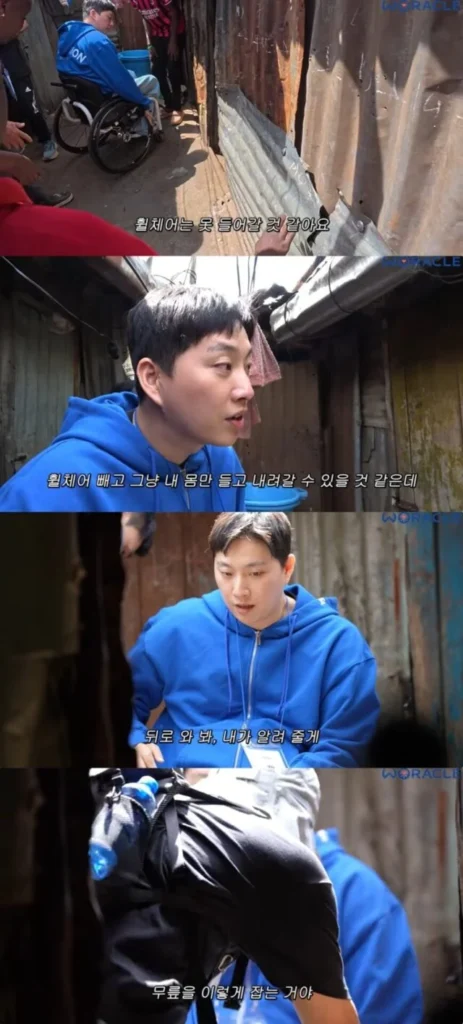
The footage depicts the couple visiting a slum area to meet with children living in extreme poverty. The infrastructure of the region presented significant challenges for Park We, who uses a wheelchair due to paralysis. Navigating the rough, unpaved, and narrow corridors of the slum required constant physical intervention from other members of the volunteer group. When faced with stairs or steep inclines, volunteers were seen lifting the wheelchair or providing direct physical support to ensure Park We could reach the intended destinations.
In one specific segment that has drawn retroactive criticism, Park We is shown instructing volunteers on how to safely transport him into a residence. Recognizing the physical constraints of the space, he suggested that he could be moved more easily if his body were lifted independently of the wheelchair. "I think I can go down by lifting only my body without the wheelchair," he told the group, before providing technical instructions: "Come behind me, I’ll show you how." He was seen directing a man in front to hold his knees and another person behind him to provide stabilization, while simultaneously warning them to "be careful with your feet and your head" to prevent injury during the maneuver.
Shift in Public Sentiment: From Support to Skepticism
At the time of its original release, the Kenya documentary was largely met with praise. Supporters lauded Park We for his courage in traveling to a developing nation despite his physical limitations and commended Song Jieun for her dedication to humanitarian causes. However, following a series of recent controversies, the narrative has shifted.
A segment of the online community has begun to view the Kenya trip through a more critical lens, questioning whether the presence of a wheelchair user in a structurally inaccessible slum placed an undue burden on the local and accompanying volunteers. Critics on various social media platforms and community forums have voiced "uncomfortable opinions," suggesting that the trip may have been more about content creation than effective aid.
Common criticisms include assertions that the volunteers "worked twice as hard" to accommodate Park We and suggestions that direct financial donations would have been more impactful than a high-resource physical visit. Some netizens questioned the necessity of traveling to Kenya when domestic social issues in South Korea remain pressing. These reactions highlight a growing trend in digital culture where the perceived "performative" nature of influencer-led charity is scrutinized for its logistical costs and ultimate benefit to the recipients.
The Catalyst: The KTX Fall Accident Controversy
The catalyst for this renewed scrutiny was an incident that occurred on August 21, 2024. Park We released CCTV footage of himself falling while attempting to disembark from a KTX train. The video was intended to highlight the difficulties faced by disabled individuals when using public transportation and to perhaps call for better safety measures or assistance protocols.
However, the public reaction was not as sympathetic as might have been expected. While many fans offered support, a significant number of viewers expressed discomfort with the release of the footage. Some argued that the video appeared to place blame on railway staff or the infrastructure in a way that felt unfair, while others questioned the motive behind sharing such a distressing personal moment on a public platform. The backlash suggested a "sympathy fatigue" among some segments of the audience, who perceived the post as an attempt to garner attention through a narrative of victimhood.
Since the KTX video sparked this backlash, Park We has not issued a formal statement addressing the specific criticisms. This silence has allowed speculation to fester, leading to the resurfacing of other aspects of his past and his public persona.
Emerging Allegations and the "Hak-pok" Narrative
Compounding the KTX controversy is a series of unverified but highly damaging allegations that have emerged on Korean community boards. As is common when a public figure in South Korea faces a "fall from grace," anonymous posters have come forward with claims regarding Park We’s life prior to his accident.
These accusations range from involvement in school violence (often referred to as "hak-pok" in South Korea) to claims that he served time in a juvenile detention center during his youth. It is important to note that these allegations remain entirely unsubstantiated by official records or credible primary sources. Nevertheless, in the court of public opinion, such rumors can be devastating. The "hak-pok" narrative is particularly potent in South Korean culture, where past bullying behavior is often viewed as a definitive indicator of character, frequently leading to the permanent "canceling" of celebrities.
Park We’s silence in the face of these specific accusations has been interpreted by some as a tactical retreat, while others see it as a refusal to dignify baseless rumors with a response. Regardless of their veracity, these claims have significantly broadened the scope of the controversy, moving it beyond a debate over wheelchair accessibility to a wholesale interrogation of his moral standing.
Chronology of Recent Events
To understand the current state of the controversy, it is necessary to look at the timeline of events that led to this impasse:
- October 2023: Park We and Song Jieun release the "Weracle" Kenya volunteer documentary. The reception is overwhelmingly positive, focusing on their "miracle" romance and humanitarian spirit.
- Late 2023 – Mid 2024: Park We continues to grow his brand, appearing on various broadcast programs and speaking engagements as a symbol of hope for the disabled community.
- August 21, 2024: Park We uploads CCTV footage of his fall at a KTX station. The video immediately triggers a divide in public opinion.
- Late August 2024: Online communities begin to circulate unverified rumors regarding Park We’s past, including school violence and juvenile delinquency.
- Early September 2024: Netizens revisit the Kenya volunteer video, re-evaluating it through a critical lens and accusing the creator of being a "burden" to other volunteers.
- Present: Park We remains inactive regarding the controversies, while public debate continues to intensify across social media platforms.
Broader Implications for Disability Advocacy and Content Creation
The situation involving Park We touches upon several sensitive issues within the realm of modern media and social advocacy.
1. The Logistics of Inclusivity
The debate over the Kenya trip raises a difficult question: Should disabled individuals refrain from high-effort humanitarian work if their presence requires significant assistance? From a disability rights perspective, the argument is that disabled people have as much right to participate in global outreach as anyone else, and that the assistance provided by others is a form of community support, not a "burden." However, the "content-first" nature of YouTube often blurs the line between genuine participation and a staged narrative, leading to the skepticism currently being directed at Park We.
2. The Vulnerability of the "Inspirational" Narrative
Park We’s entire brand, "Weracle," is built on being an "inspirational" figure. This archetype is notoriously fragile in the digital age. When an individual is marketed as a paragon of virtue or a "miracle," the public often holds them to an impossibly high standard. Any perceived lapse in judgment—such as the KTX video—can lead to a rapid deconstruction of their entire public history.
3. The Power of Unverified Allegations
The inclusion of school violence rumors in this controversy demonstrates the volatility of South Korean online culture. The "bombardment" of accusations, as seen in recent weeks, shows how easily a targeted campaign of character assassination can piggyback on a legitimate debate over a specific incident (the KTX fall).
Analysis of the Public Reaction
Data from social media sentiment analysis tools suggests that the criticism against Park We is not monolithic. While a vocal minority is calling for his retirement from public life, a significant portion of his core fanbase remains loyal, arguing that he is being unfairly targeted by "witch-hunt" tactics.
The criticism regarding the Kenya trip, in particular, has been analyzed by some social commentators as a reflection of "ableist" undercurrents. They argue that criticizing a disabled man for needing help while volunteering effectively suggests that disabled people should remain hidden or only operate in perfectly accessible environments. Conversely, the "burden" argument focuses on the ethics of resource allocation, suggesting that the energy spent assisting Park We could have been spent directly on the Kenyan children.
Conclusion and Potential Outcomes
As of now, Park We stands at a crossroads. The transition from a beloved motivational figure to a subject of intense public scrutiny is a path many influencers have failed to recover from. The silence from the Weracle camp may be a strategic choice to wait for the news cycle to move on, but in the era of viral accountability, silence is often filled by the loudest critics.
For Park We to restore his public image, industry experts suggest a multi-pronged approach: providing clarity on the KTX incident without appearing defensive, addressing the Kenya criticisms by highlighting the long-term impact of the mission (beyond the video itself), and potentially addressing the "hak-pok" rumors if they continue to gain traction.
The case of Park We serves as a cautionary tale for the modern influencer. It illustrates that in the digital economy, past "good deeds" are not an insurance policy against future criticism, and that the transparency of a "vlog-style" life can be a double-edged sword when the public’s perception shifts from admiration to interrogation. Whether Park We can reclaim his status as a "miracle" worker or if this controversy marks a permanent shift in his career remains to be seen. What is clear, however, is that the intersection of disability advocacy, international volunteerism, and the relentless scrutiny of the internet has created a complex crisis that requires more than just silence to resolve.
Related News