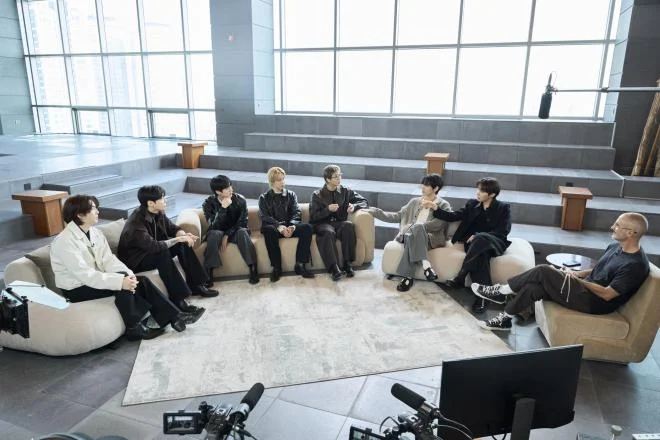
In an expansive and introspective dialogue with Apple Music’s Zane Lowe, the seven members of BTS—RM, Jin, SUGA, j-hope, Jimin, V, and Jung Kook—offered an unprecedented look into the internal mechanics of the world’s most successful musical group as they navigate a pivotal transition in their decade-long career. The interview, which served as a reflective cornerstone for their latest creative era, moved beyond the promotional tropes of the music industry to address the existential realities of fame, the weight of national service, and the deliberate effort required to maintain a collective identity in a landscape that often prioritizes individual brand expansion. Rather than presenting a rehearsed front of effortless permanence, the members articulated a philosophy of intentionality, suggesting that the survival of BTS is not a historical inevitability but a daily choice practiced by seven individuals who have grown from teenagers into men under a global microscope.
The Philosophy of Persistence: Choosing "Forever" Over Certainty
The conversation began with a fundamental inquiry into the group’s longevity, a topic that has fueled intense speculation since the group announced their "Chapter 2" in 2022, which saw them pause group activities to fulfill mandatory South Korean military duties and pursue solo projects. For Jin, the eldest member and the first to complete his service, the concept of "forever" is a misnomer if viewed as a guarantee. He noted that while nothing in the physical world is truly permanent, the value of an endeavor is found in the care and preservation invested by those involved. This sentiment was echoed by j-hope, who argued that longevity exists in the "in-between" spaces of shared will. He posited that as long as the seven members maintain a consensus to move forward, the form of the group will remain intact, regardless of external pressures.
SUGA, known for his pragmatic and often stoic outlook, envisioned a future where the group continues to produce music well into their later years. His perspective emphasized a shift from obligation to autonomy; the goal is no longer to meet industry benchmarks but to continue creating because they find personal fulfillment in the collaborative process. V added a layer of grounded simplicity to this discourse, suggesting that the secret to their decade-long cohesion is not found in grand declarations or contractual obligations, but in the consistent, quiet effort of showing up for one another daily. This collective outlook reframes BTS not as a product of a corporate machine, but as a voluntary brotherhood.
A Seamless Reunion: The Transition from Military Service to Group Activity
The timeline of BTS’s return to the spotlight is inextricably linked to South Korea’s Conscription Law, which requires all able-bodied men to serve between 18 and 21 months in the military. The group’s staggered enlistment, beginning with Jin in December 2022 and concluding with the remaining members in late 2023, created a period of individual growth that many analysts predicted might dilute the group’s collective brand. However, Jung Kook described the reunion process as an instinctive return to a "default state." Having spent his entire adult life as part of the ensemble, he noted that the transition back into group dynamics felt less like a strategic comeback and more like a natural continuation of an interrupted sentence.
The synchronization of their military timelines was not merely a matter of administrative planning but a reflection of their shared commitment to minimize the group’s hiatus. This period of absence, rather than creating distance, appears to have sharpened their appreciation for the group’s internal ecosystem. The members noted that the transition back into being "seven" again happened without the need for intense rehearsals or psychological adjustments, suggesting that the "BTS identity" had become a permanent fixture of their individual personas.
Jimin and the Refinement of Purpose
For Jimin, the period of military service served as a profound psychological turning point. Away from the choreographed precision of the global stage, he found himself observing the work ethic of younger soldiers who approached mundane tasks with total dedication. This experience prompted a reevaluation of his own drive and artistic purpose. Far from viewing the hiatus as a loss of momentum, Jimin utilized the time to sharpen his craft. Alongside Jung Kook, he continued to develop musical ideas even within the constraints of military life, proving that the group’s creative engine does not require the infrastructure of a recording studio to function. His takeaway was a renewed focus on the value of time, viewing his return to music not as a resumption of a job, but as a deliberate investment in what he deems most meaningful.
Jin’s Journey and the Role of Leadership
Jin’s reflection on his path within BTS highlighted the importance of mentorship and interpersonal gratitude. Having entered the group with a background in acting rather than music, he spoke candidly about the influence of RM and j-hope in shaping his musical identity. He credited them with helping him find genuine joy in the creative process, transforming what could have been a career of "accidental" success into one of intentional artistry.
RM, as the group’s leader, discussed the complexities of his role after 15 years. He described the evolution of the group into a family unit where communication often transcends verbal language. However, he did not shy away from the burdens of leadership, admitting that the responsibility can sometimes feel like a solitary weight. His ongoing challenge remains balancing his role as a guide with his identity as one of the seven members. This vulnerability provides a rare glimpse into the psychological toll of leading a global phenomenon, emphasizing that the group’s stability is maintained through constant internal negotiation.

Creative Expansion and the Significance of ARIRANG
The group’s latest project, titled ARIRANG, represents a significant cultural and creative milestone. The title refers to a traditional Korean folk song that is often considered the unofficial national anthem of Korea, symbolizing themes of longing, resilience, and home. RM explained that during their time in the military, the emotional weight of "Arirang"—a song passed down through generations—became personally resonant. The distance from their fans (ARMY), the stage, and their established lives fostered a deeper connection to their cultural heritage.
By choosing ARIRANG as a thematic anchor, BTS is attempting to bridge the gap between Korean traditionalism and global pop music. The album features collaborations with international producers, such as El Guincho, known for his work with Rosalía. Jung Kook highlighted that working with such diverse creative voices introduced new textures to their sound, pushing them out of their comfort zones. The objective of ARIRANG is to take a specific Korean sentiment—han (a unique Korean emotion of grief and resentment) and longing—and translate it into a universal musical language.
From Big Hit to HYBE: A Legacy of Shared Growth
The interview also touched upon the meteoric rise of their management company, which began as Big Hit Entertainment—a small, underdog agency—and evolved into HYBE, a multi-national conglomerate. RM recalled the early days when a handful of staff members shared every responsibility, a stark contrast to the current corporate infrastructure. Despite this scale, the members maintain that their grounding force remains their relationship with their fans.
Data from the past decade illustrates the "BTS Effect" on the global economy and the music industry. As of 2023, BTS was estimated to contribute over $3.6 billion annually to the South Korean economy. Their fans, the ARMY, have grown alongside them, transitioning from students to working professionals, parents, and community leaders. This demographic shift in the fandom has transformed the relationship from a standard artist-fan dynamic into a shared journey of maturation. The members noted that seeing fans hit life milestones—such as marriage or career achievements—mirrors their own evolution, creating a symbiotic legacy that extends beyond music charts.
Broader Impact and the Future World Tour
As BTS prepares for a massive world tour and a new era of global engagement, the stakes have shifted. They are no longer in a phase of seeking validation or breaking into new markets; they are now in the business of legacy-building. The upcoming tour is expected to be one of the highest-grossing in history, with industry analysts predicting record-breaking ticket demand following their multi-year absence from the touring circuit.
The implications of BTS’s return are significant for the K-pop industry at large. Their ability to successfully navigate the "military hiatus"—a period that has historically ended the careers of many Korean male groups—provides a blueprint for future generations. It demonstrates that a group’s brand can survive, and perhaps even strengthen, through individual hiatuses if the core message and internal chemistry remain intact.
Final Analysis: The Unspoken Alignment
The most striking revelation from the Apple Music interview was the revelation by j-hope that the decision to continue as a group did not require extensive debate or formal meetings. There was an "unspoken alignment"—a quiet synergy that allowed them to move into this next chapter with collective confidence.
BTS’s current trajectory suggests that they are redefining the lifecycle of a global pop act. By rejecting the pressure of "forever" as a marketing slogan and embracing it as a practiced discipline, they have moved into a space of artistic maturity. They move forward not out of contractual necessity, but out of a genuine desire to explore the limits of their collective potential. As they bridge their Korean roots with a global future through ARIRANG, BTS continues to serve as a singular case study in how a group can maintain its soul while operating at the pinnacle of the global entertainment industry. The strongest legacies, as the interview concluded, are not built on the certainty of the future, but on the daily decision of individuals to stay together.