The Socio-Political Implications of South Korea’s First Female Presidency and the Cultural Reflection in Popular Media
Article Editorial Team
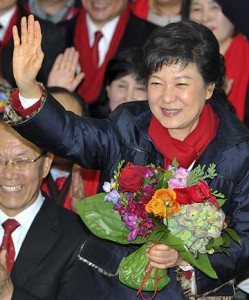
The transition of power in South Korea between 2012 and 2013 marked a significant shift in the nation’s political trajectory, defined by the election and inauguration of Park Geun-hye. As a veteran representative of the conservative Saenuri Party (formerly the Grand National Party), Park secured the presidency in December 2012 by a narrow margin, officially becoming the first female head of state in the history of the Republic of Korea. Her ascension to the Blue House (Cheong Wa Dae) was viewed by many international observers as a potential turning point for gender dynamics in a country historically defined by deeply entrenched Confucian patriarchal values. However, the cultural response to this political milestone, most notably exemplified by the K-pop group Girl’s Day and their 2013 single "Female President," highlighted a profound disconnect between symbolic political representation and the lived socio-economic realities of South Korean women.
The Political Context of Park Geun-hye’s Election
Park Geun-hye’s path to the presidency was inextricably linked to her family legacy. She is the daughter of Park Chung-hee, the military leader who ruled South Korea from 1961 until his assassination in 1979. While Park Chung-hee is credited with spearheading the "Miracle on the Han River"—the rapid industrialization and economic growth of South Korea—his era was also marked by authoritarianism and human rights suppressed. Consequently, Park Geun-hye’s candidacy was polarizing. Supporters viewed her as a stabilizing force who inherited her father’s economic acumen, while opponents, particularly within the progressive Democratic United Party (Minju Party), accused her of benefiting from a dynastic political structure and failing to adequately distance herself from her father’s autocratic past.
Despite these controversies, Park’s victory was hailed as a breakthrough for women in leadership. During her campaign, she promised a "new era of hope" and suggested that her leadership would bring a "mother’s touch" to governance, focusing on social welfare and national security. For a nation that consistently ranked low in global gender equality indices, the presence of a woman at the highest level of government suggested a "watershed" moment for the advancement of women’s rights.
Socio-Economic Realities for Women in South Korea (2012-2013)
To understand the impact of Park’s presidency, one must examine the socio-economic landscape of South Korea at the time. Despite being a highly developed OECD member, South Korea possessed one of the most significant gender disparities among industrialized nations. In 2013, data from the Organization for Economic Cooperation and Development (OECD) indicated that South Korea had the highest gender wage gap in the group, with women earning approximately 36.6% less than their male counterparts.
Furthermore, the "glass ceiling" in corporate Korea remained largely impenetrable. Women’s participation in the labor market followed a distinct "M-curve" pattern: high participation in the early 20s, a sharp decline in the 30s as women left the workforce to raise children, and a return to low-paying or part-time work in their 40s. Structural barriers, such as the lack of affordable childcare and a corporate culture that demanded long hours and evening socializing (hoesik), made it nearly impossible for many women to balance professional advancement with family life. Additionally, legal restrictions on reproductive rights were stringent; at the time, abortion remained illegal in most circumstances under the Criminal Act of 1953, a law that would not be ruled unconstitutional until 2019.
Chronology of the "Female President" Cultural Phenomenon
The intersection of this political milestone and popular culture reached its peak in the summer of 2013. The following timeline outlines the progression from the political arena to the entertainment industry:
- December 19, 2012: Park Geun-hye wins the 18th presidential election with 51.6% of the vote.
- February 25, 2013: Park Geun-hye is officially inaugurated as the President of South Korea.
- April 2013: Media attention intensifies around Girl’s Day member Hyeri following reports of her relationship with veteran idol Tony Ahn, significantly boosting the group’s public profile.
- June 24, 2013: Girl’s Day releases the music video and single "Female President," explicitly referencing the new political reality in its title and marketing.
- Late 2013: Analysts and social critics begin debating the efficacy of "girl power" concepts in K-pop, using "Female President" as a primary case study for the commodification of feminist rhetoric.
Analysis of "Female President" as a Cultural Text
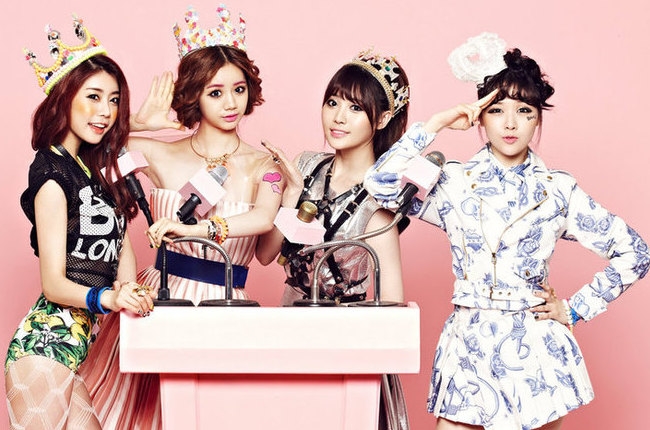
When Girl’s Day, a group then rising toward the "top tier" of the K-pop industry, announced their comeback with a song titled "Female President," expectations were high for a contemporary anthem of empowerment. The group had previously undergone several lineup changes and was transitioning from a "cute" aesthetic to a more sophisticated, "sexy" image.
However, upon the song’s release, critics noted a stark contrast between the title’s political gravitas and the lyrical content. The song’s central thesis did not revolve around glass ceilings, equal pay, or political agency. Instead, it used the existence of a female president as a rhetorical justification for a woman to take the initiative in a romantic encounter—specifically, the act of kissing a man first. The lyrics ask, "The president of our country is now a woman / So what’s the problem? Why can’t a girl do it [kiss first]?"
From a journalistic and sociological perspective, this framing is significant. It reduces the monumental achievement of a female presidency to a tool for navigating traditional dating etiquette. While the song encourages women to be "go-getters," it remains firmly rooted in the male-female binary, where a woman’s empowerment is measured by her ability to secure a male partner’s affection.
Visual Representation and Contradictory Imagery
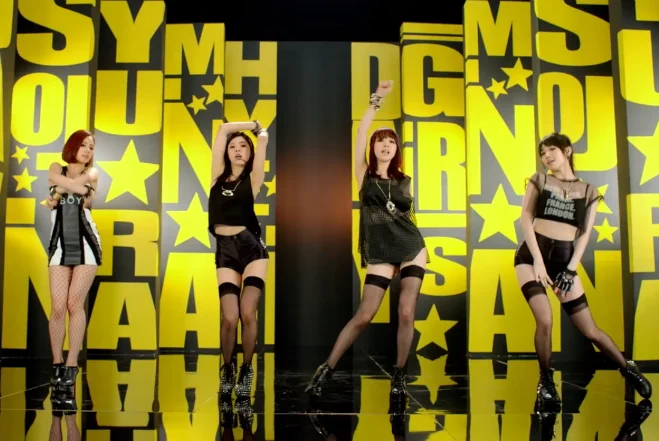
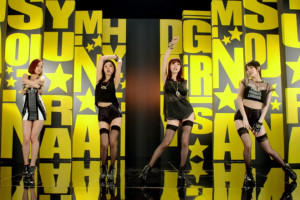
The music video for "Female President" further complicated its message of empowerment through its visual choices. The styling included controversial "nude-tone" body suits and traditional "sexy" choreography designed to appeal to a predominantly male demographic (the "uncle fans" or samchon fans). This created a paradox: a song ostensibly about female power was packaged using the male gaze’s standard toolkit.
One notable element of the video was the portrayal of a romantic relationship between two members, Minah and Hyeri. Hyeri was styled in a masculine, androgynous suit with short hair, playing the "male" role, while Minah portrayed the "female" role. The video culminates in a near-kiss where Minah pulls Hyeri by the tie. While some viewers interpreted this as a daring subversion of gender roles, others viewed it as a superficial performance of "girl-on-girl" intimacy intended for titillation rather than a genuine exploration of queer identity or gender fluidity.
Public and Critical Responses
The reaction to the song was mixed. On one hand, it was a commercial success, reaching the top ten on the Gaon Digital Chart and further solidifying Girl’s Day’s status as a leading girl group. Many fans praised the group’s confidence and the catchy, high-energy production.
On the other hand, social commentators and feminist scholars in South Korea criticized the track for its "hollow" empowerment. The consensus among these critics was that the song utilized the "Female President" branding to appear progressive while reinforcing regressive stereotypes. The lyrics, which describe the female protagonist as feeling "dizzy," "like a baby," and "crying" in the presence of her love interest, directly contradicted the image of a decisive leader suggested by the title.
There was no official response from the Blue House regarding the song, but the cultural conversation it sparked highlighted the limits of symbolic representation. The mere presence of a woman in power did not automatically translate into a shift in the way women were portrayed or valued in popular media.
Broader Impact and Long-term Implications
The "Female President" era serves as a historical marker for the complexities of South Korean feminism during the early 2010s. It demonstrated how K-pop, as a commercial industry, often adopts the language of social change to create "concepts" without necessarily engaging with the underlying social issues.
In the years following the release of "Female President," the discourse around gender in South Korea shifted dramatically. The "Escape the Corset" movement and the rise of the #MeToo movement in 2018 brought issues of sexual harassment, digital sex crimes (molka), and systemic discrimination to the forefront of national conversation. Compared to the substantive demands of these later movements, the "empowerment" offered by Girl’s Day in 2013 appears as a relic of a time when gendered progress was often equated with consumerist choices or minor deviations in dating norms.
Furthermore, the legacy of Park Geun-hye’s presidency itself took a dark turn. Her 2017 impeachment and subsequent imprisonment for corruption and abuse of power complicated the narrative of female leadership in South Korea. For many, her downfall was a personal failure of governance, but for others, it was used as a pretext to unfairly criticize the capability of women in high office, further illustrating the precarious nature of being a "first" in a patriarchal society.
In conclusion, the release of "Female President" by Girl’s Day remains a significant case study in the intersection of pop culture and politics. It serves as a reminder that while political milestones like the election of a first female president provide a necessary foundation for change, the cultural and social structures that define the daily lives of citizens require more than symbolic gestures to be truly transformed. The impact of the song on society was ultimately negligible in terms of policy or structural reform, but its existence provides a valuable snapshot of a nation grappling with its own identity at the dawn of a new political era.
Related News