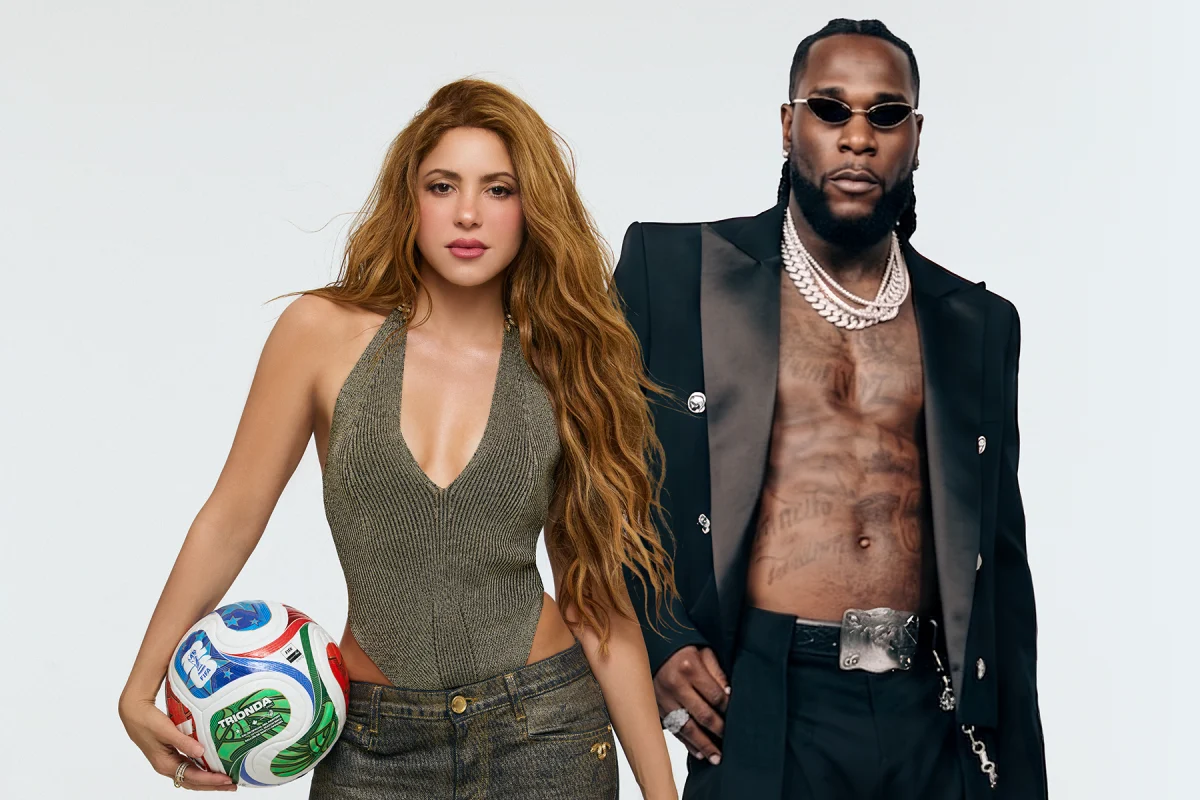
As the FIFA World Cup electrifies audiences worldwide, its official anthem, "Dai Dai," a collaboration between Colombian pop superstar Shakira and Nigerian artist Burna Boy, has ascended to the pinnacle of the Billboard Global Excl. U.S. chart. This significant achievement marks the song’s first week in the coveted No. 1 position, a six-spot leap from its previous standing at No. 7. The infectious track, imbued with the vibrant energy of global football and the distinct musical styles of its acclaimed artists, is resonating strongly beyond the tournament’s immediate sphere.
The song’s growing momentum is not confined to international territories. "Dai Dai" has also begun to make its mark on the U.S. music scene, climbing one position to No. 74 on the highly competitive Billboard Hot 100 chart this week. This success further solidifies Shakira’s enduring legacy as an artist capable of producing World Cup anthems that transcend the sport itself. Her 2010 collaboration with Freshlyground, "Waka Waka (This Time for Africa)," a song that became synonymous with the South African World Cup, previously reached No. 38 on the Hot 100, underscoring Shakira’s consistent ability to connect with a global audience through the unifying power of football and music.
The impressive chart performance of "Dai Dai" has sparked discussions among music industry analysts and fans alike regarding its deeper significance for both Shakira and Burna Boy, as well as its potential to evolve into a mainstream hit within the United States.
The World Cup’s Musical Pulse: "Dai Dai" and the Power of Global Unity
The ascent of "Dai Dai" to the No. 1 spot on the Billboard Global Excl. U.S. chart is a compelling indicator of the World Cup’s unparalleled ability to unite people through shared passion and entertainment. While the tournament’s escalating elimination stages undoubtedly fuel the song’s immediate popularity, its sustained connection with listeners suggests a resonance that extends beyond mere association with the sporting event.
Cata Balzano, a music critic, posits that the song’s success is intrinsically linked to the global fervor surrounding the World Cup. "As the World Cup is the biggest sporting event in the world, anything associated with it – especially the official song – will naturally gain massive global exposure," Balzano explains. "Between streaming, social media clips from the matches, fan-generated content, and stadium moments where attendees use the song as the soundtrack to their experiences, its popularity right now isn’t surprising."
However, Balzano also emphasizes the undeniable influence of Shakira’s established global stature. "Shakira has built a reputation for delivering World Cup anthems that go beyond the tournament itself," she notes. "Time and again, her songs become inseparable from the event, which is why fans still embrace them long after the tournament ends." The impending performance of "Dai Dai" by Shakira and Burna Boy at the FIFA World Cup Final halftime show is anticipated to provide a further surge in streams and visibility, akin to the promotional boost artists receive from Super Bowl halftime performances.
Kyle Denis, another industry observer, acknowledges the World Cup’s foundational role but sees nascent signs of broader appeal. "I think it’s probably still the former over the latter; ‘Dai Dai’ has a bigger platform than 95% of songs out right now," Denis states. "Nevertheless, I have begun to hear this in non-football contexts, so it’s beginning to resonate outside of World Cup festivities."
Lyndsey Havens highlights the song’s multifaceted appeal. "I think it’s a perfect storm of both," Havens comments. "One of the most prominent parts of the World Cup is the global camaraderie that comes with it, so it makes total sense that one song would emerge as the soundtrack to all that excitement and anticipation and community." She adds that the song’s inherent quality and its universal message of resilience contribute to its broader appeal. "The fact that ‘Dai Dai’ is a generally great song with a universal message of persistence and strength only sweetens the deal; the collaboration between Shakira and Burna Boy feels natural enough that it would work as a single even outside of being an official sports game anthem, which was likely the goal all along."
Isabela Raygoza points to Shakira’s unique historical connection with the World Cup as a pivotal factor. "A huge part of that is simply Shakira," Raygoza asserts. "She isn’t just another artist attached to a FIFA campaign – she’s someone audiences already associate with the World Cup on a near-mythic level." The song’s global design, featuring the organic pairing of Shakira and Burna Boy, is also credited with expanding its reach. "His presence adds Afro-fusion texture and another layer of international pull," Raygoza explains. "Add in the music video’s football idol appearances (Lionel Messi, Kylian Mbappé, Erling Haaland, etc.), and the song starts to feel like something that can likely live past the final whistle."
Andrew Unterberger, reflecting on past World Cup anthems, emphasizes the song’s intrinsic merit. "Obviously the World Cup is a main thing, but there have been numerous World Cup anthems from big-name artists that haven’t majorly connected on a Billboard level," Unterberger observes. "The song still has to be good, and to feel right – and it’s a win on both counts for ‘Dai Dai’."
The Impact of "Dai Dai": A Look at the Artists’ Trajectories
The success of "Dai Dai" carries distinct implications for both Shakira and Burna Boy, each artist leveraging the collaboration to advance their careers in unique ways.
For Shakira, the song’s chart performance serves as further testament to her enduring status as a global music icon and her unparalleled ability to craft anthemic World Cup songs. "For Shakira, it’s another reminder that she has mastered the art of creating World Cup anthems," explains Cata Balzano. "Not only has she charted consistently throughout her career, but when she records a song for a global event, it also becomes a chart-topping hit. That’s an indicator of her longevity and cultural star power, especially since she is the artist with the most World Cup theme songs in the tournament’s history."
Conversely, for Burna Boy, "Dai Dai" represents a significant milestone, introducing his distinctive Afro-fusion sound to an even broader international audience at one of the world’s most prominent sporting spectacles. "For Burna Boy, this marks an important new phase in his career as an artist," Balzano continues. "It’s his first official FIFA World Cup song, and it introduces his sound to an even larger audience globally. The track leans heavily into Afro-fusion beats, allowing the Nigerian star to bring African rhythms and musical traditions to the forefront of one of the world’s biggest sporting events. From a representation standpoint, that’s incredibly significant."
Kyle Denis offers a nuanced perspective, suggesting the song’s immediate impact might be more pronounced for Burna Boy. "Definitely Burna Boy," Denis states. "Shakira’s been doing fine recently between her stadium-packing Las Mujeres Ya No Lloran World Tour and her Copacabana show that drew over two million people. Burna, on the other hand, is coming off a tepidly received album (last year’s No Sign of Weakness hit No. 200 on the Billboard 200) and the controversy around his refusing to continue a show after catching a fan falling asleep (he later apologized)." Denis highlights that Shakira has recently charted on the Hot 100 with "Zoo," while "Dai Dai" marks Burna Boy’s first appearance on the chart since 2023, underscoring the song’s significance for his recent chart presence.
Lyndsey Havens views the collaboration as equally impactful for both artists, albeit for different reasons. "For wildly different reasons, I think it holds equal weight for both," Havens says. "For Shakira, it’s proof she is this eternal hitmaker, and for Burna it’s proof he can hold his own in that same conversation." She elaborates, "One could argue it’s a bigger opportunity for Burna, but it’s not really – he’s been at this for 15 years now with his own list of accolades and historic moments. I think because they’re coming at this collaboration from a level playing field, they only helped it hit harder."
Isabela Raygoza believes the song’s impact on Shakira’s legacy is profound. "I’d say it means more for Shakira in terms of legacy, even if it’s enormously valuable for both artists," Raygoza notes. "For Burna Boy, huge. It gives him a place inside one of the largest global entertainment stages imaginable and exposes his sound to audiences that may not otherwise engage with Afro-fusion in a direct way." She elaborates on Shakira’s unique position: "But for Shakira, ‘Dai Dai’ lands on a different level because it reinforces a narrative that was already forming and now feels almost undeniable: she is the defining World Cup pop superstar of her generation. It adds another chapter to a catalog that already includes songs deeply tied to the tournament’s emotional history. Whether you want to count ‘Hips Don’t Lie/Bamboo,’ ‘Waka Waka,’ ‘La La La,’ or now ‘Dai Dai,’ the broader point is that Shakira has become one of the few artists whose name is permanently embedded in FIFA memory. That’s bigger than chart success – it speaks to her longevity and cultural imprint."
Andrew Unterberger concurs that while the short-term benefits may favor Burna Boy, the long-term implications are more significant for Shakira. "In the short-term it may be a bigger win for Burna Boy, but long-term it has to be Shakira," Unterberger states. "If she wasn’t already, she’s now unquestionably the Queen of the World Cup now from a musical perspective – maybe just the Queen of Fútbol in general – which is something that could provide perennial dividends for her, à la Mariah Carey and the holidays."
Charting the U.S. Landscape: "Dai Dai" and its American Ambitions
While "Dai Dai" has achieved undeniable global success, its performance on the Billboard Hot 100, currently at No. 74, prompts questions about its potential to become a major hit in the United States.

Cata Balzano anticipates the song will maintain its presence on the Hot 100 throughout the tournament, given its role as a soundtrack to fans’ experiences. However, she suggests a dramatic surge in the U.S. market is unlikely if it hasn’t already occurred. "However, if it hasn’t broken into the upper tier of the chart by now, it’s unlikely to see a dramatic jump in the U.S. market," Balzano explains. "That said, streams will most certainly continue to grow as the tournament moves to its final phase and beyond. The World Cup final and Madonna, BTS and Shakira’s halftime performance could give the song a significant boost, both domestically and internationally, even after the tournament has ended."
Kyle Denis remains cautiously optimistic about further growth. "We still have some time until the Closing Ceremony, so I’m sure ‘Dai Dai’ will continue growing," Denis says. "I don’t think it will become a smash that spends weeks in the chart’s uppermost reaches – I expect this summer to have a smattering of different niche-defining songs – but I’d be surprised if it didn’t at least have a healthy lifespan within the Hot 100’s top 40."
Lyndsey Havens believes the song’s destiny lies in its global appeal, suggesting it will remain more of a "fringe hit" in the U.S. "I think it will remain a fringe hit here, and I’m good with that," Havens states. "The power of the song is in its global appeal and to see that reflected atop our global chart is proof it delivered exactly as intended."
Isabela Raygoza echoes this sentiment, emphasizing the song’s international appeal. "I think it’s more likely to remain significantly bigger globally than in the U.S., and that’s not really a weakness of the song – it’s a reflection of what kind of hit it is," Raygoza asserts. "The Hot 100 is a U.S.-only chart, while Global Excl. U.S. is better suited to measure a song like this, since ‘Dai Dai’ is tied to a global sporting event and powered by two artists with massive international audiences. That gap between the charts kind of tells the story: its appeal is broader than the U.S. market." She adds that while further U.S. growth is possible, particularly with the tournament’s conclusion and the presence of other major artists releasing World Cup-related music, a dominant U.S. hit status is less probable. "My instinct is that it may climb modestly, but its real story is international."
Andrew Unterberger suggests that continued U.S. success is contingent on the performance of the U.S. team and the overall excitement of the tournament. "I think that it could continue to climb – particularly if the U.S. continues to excel, and if the tournament stays spicy in general," Unterberger comments. "I doubt it’ll really ever reach escape velocity to the point where it keeps growing independently of the tournament, but a top 40 berth in the final weeks certainly isn’t out of the question."
Beyond "Dai Dai": Other World Cup Contenders
The landscape of World Cup-associated music is rich, but "Dai Dai" has emerged as the dominant force. Analysts suggest that while other songs may gain traction, "Dai Dai" is likely to remain the clear leader in terms of cultural impact and commercial success.
Cata Balzano firmly believes "Dai Dai" will retain its standing. "I think ‘Dai Dai’ will remain the clear standout," Balzano states. "I listened to the entire FIFA World Cup album while covering its release, and none of the other tracks have achieved the same level of visibility or cultural association with the tournament. ‘Dai Dai’ is the song fans immediately associate with the tournament. It’s the track that’s consistently used in reels, videos, stadium content and social media posts, making it the defining musical anthem of this edition of the tournament."
Kyle Denis attributes "Dai Dai’s" leadership to the quality of other offerings. "Given that most of these songs aren’t great, I think ‘Dai Dai’ remains the clear leader here," Denis remarks.
Lyndsey Havens agrees that "Dai Dai" will likely hold its position. "There have been so many songs released for or in association with the World Cup, many of them great," Havens says. "But I think ‘Dai Dai’ will remain the clear leader – in part because there are so many other options. This song has already emerged as the clear frontrunner favorite, and I don’t see that changing."
Isabela Raygoza acknowledges potential contenders but maintains "Dai Dai’s" leading status. "Right now, I think ‘Dai Dai’ remains the clear leader, both commercially and culturally," Raygoza notes. "There are other songs in the 2026 World Cup orbit that have potential. ‘Jump’ has a built-in familiarity because of the Van Halen sample, plus J Balvin, Travis Barker and Steve Vai give it a stadium-ready punch that makes sense for a tournament this big. And now with Madonna and Feid entering the conversation with ‘Read My Lips,’ there’s another late-stage contender that could generate attention because of sheer star power and novelty. But even with all that, ‘Dai Dai’ still feels like the song that has already won the emotional branding war. It’s the one most closely fused with the tournament in people’s minds. That matters more than being on an official album or having a famous feature."
Andrew Unterberger suggests a surprising contender could emerge if the U.S. team continues to perform well. "It’s probably ‘Dai Dai,’ but don’t disregard another entry from the if-Team-USA-keeps-winning file: John Denver’s early-’70s country classic ‘Take Me Home, Country Roads’," Unterberger advises. "The song is really starting to catch on with U.S. audiences as the team’s official-unofficial anthem, and if they get another big W or two in the elimination stages, it could take over in a huge way. Wouldn’t be the first time, certainly."
The Enduring Anthems: All-Time Favorite World Cup Songs
When reflecting on the rich history of World Cup music, certain songs stand out for their lasting impact and ability to capture the spirit of the tournament.
Cata Balzano names Shakira’s "Waka Waka (This Time for Africa)" as her all-time favorite, with Ricky Martin’s "The Cup of Life" as a close second. "For me, Shakira’s ‘Waka Waka (This Time for Africa)’ is an all-time favorite – although Ricky Martin’s ‘The Cup of Life’ comes in a close second," Balzano states. "’Waka Waka’ perfectly conveyed the spirit of the 2010 FIFA World Cup in South Africa. Its exciting rhythm, fun lyrics and iconic choreography made it much more than a World Cup anthem for me, especially because I still enjoy listening to it. It became a global cultural phenomenon, and this was before social media was around to help promote or viralize a song. More than 15 years later, it’s still the benchmark for what a World Cup song should be."
Kyle Denis unequivocally declares "Waka Waka" as his top pick. "It will always be ‘Waka Waka’," Denis asserts. "We should have stopped commissioning new anthems after that one!"
Lyndsey Havens also favors Shakira’s 2010 hit. "Another Shakira banger, ‘Waka Waka’," Havens confirms.
Isabela Raygoza reiterates the enduring power of "Waka Waka." "For me, it’s still ‘Waka Waka (This Time for Africa),’ with ‘The Cup of Life’ by Ricky Martin and Pablo Flores as a close second," Raygoza explains. "’Waka Waka’ just feels inseparable from the energy of the World Cup – celebratory, unifying and instantly memorable. That said, ‘The Cup of Life’ remains iconic for how explosive and defining it was in shaping a modern World Cup anthem."
Andrew Unterberger offers a more left-field choice: New Order’s "World in Motion." "I’ll go a little off the board and say New Order’s ‘World in Motion,’ an irresistibly goofy 1990 singalong timed to the U.K.’s surprise rebound on the global stage," Unterberger shares. "Also a top five Alternative Airplay hit in its day!"
The conversation around "Dai Dai" and its chart performance underscores the profound connection between major global events like the World Cup and the music that soundtracks them. As the tournament progresses, the song’s ability to resonate with audiences both within and beyond the context of football will continue to be closely watched.