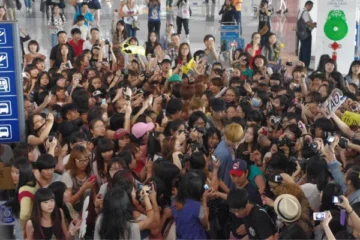
Girls Generation Secures Video of the Year at Inaugural YouTube Music Awards Signaling K-Pop Global Dominance
Article Editorial Team
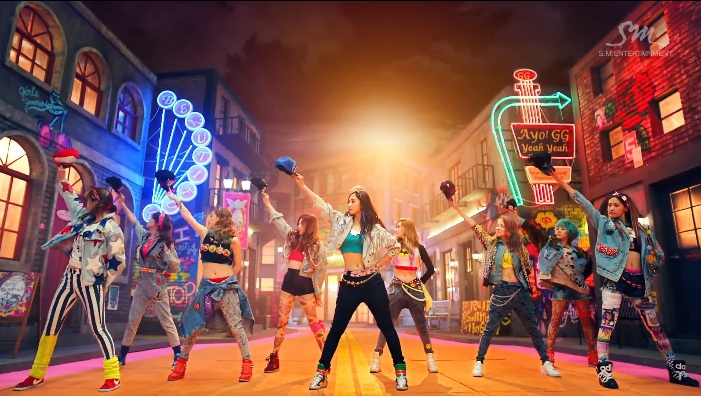
The global music landscape experienced a significant shift on November 3, 2013, as the South Korean girl group Girls’ Generation, also known as SNSD, was announced as the winner of the Video of the Year award at the first-ever YouTube Music Awards (YTMA). Held at Pier 36 in New York City, the ceremony was designed to recognize the artists and videos that had achieved the highest levels of engagement on the platform over the previous year. Girls’ Generation’s victory for their genre-bending hit "I Got a Boy" placed them ahead of some of the most prominent names in Western pop music, including Justin Bieber, Lady Gaga, Miley Cyrus, and Macklemore & Ryan Lewis. This achievement not only solidified the group’s international standing but also served as a definitive marker of the growing influence of the Korean Wave, or Hallyu, within the global mainstream.
The Inaugural YouTube Music Awards and Selection Criteria
The 2013 YouTube Music Awards represented a departure from traditional music industry ceremonies like the Grammys or the MTV Video Music Awards. Directed by acclaimed filmmaker Spike Jonze and hosted by Jason Schwartzman and Reggie Watts, the event sought to leverage YouTube’s massive data repository to determine winners based on actual user behavior rather than industry panels. The nominations were determined by analyzing technical metrics such as view counts, likes, comments, and subscriptions over the preceding 12 months.
For the Video of the Year category, the final winner was decided through social media engagement. Specifically, YouTube tracked the number of times a nomination’s specific voting link was shared across platforms like Twitter, Facebook, and Google+. This methodology favored artists with highly organized and digitally active fanbases. The criteria prioritized "virality" and "shareability," metrics that are often more indicative of a dedicated core audience than broad, passive radio play. Consequently, the win for Girls’ Generation was a direct reflection of the group’s digital footprint and the systematic efforts of their global fandom, known as SONE.
A Competitive Field of Global Superstars
The magnitude of the victory is best understood by examining the roster of nominees that Girls’ Generation outperformed. The Video of the Year category included ten nominees, representing the pinnacle of commercial success in 2013:
- Justin Bieber (feat. Nicki Minaj) – "Beauty and a Beat": A powerhouse in digital engagement with a massive "Belieber" following.
- Lady Gaga – "Applause": An artist renowned for her conceptual music videos and dedicated "Little Monsters."
- Miley Cyrus – "We Can’t Stop": A video that dominated cultural conversations and broke Vevo records at the time.
- Selena Gomez – "Come & Get It": A major radio and digital hit.
- Macklemore & Ryan Lewis (feat. Mary Lambert) – "Same Love": A socially significant anthem that saw heavy rotation.
- Demi Lovato – "Heart Attack": A strong contender with a massive domestic US audience.
- One Direction – "Best Song Ever": Perhaps the most comparable fanbase in terms of organization and digital fervor.
- PSY – "Gentleman": The follow-up to the record-breaking "Gangnam Style," representing the other major K-pop force of the era.
- Epic Rap Battles of History – "Barack Obama vs. Mitt Romney": Representing the native YouTube creator community.
When Tiffany, a member of Girls’ Generation, took the stage to accept the award, the atmosphere was a combination of triumph for the K-pop industry and visible confusion from Western media outlets unfamiliar with the group’s decade-long history in Asia.
Systematic Fandom Mobilization: The Anatomy of a Digital Victory
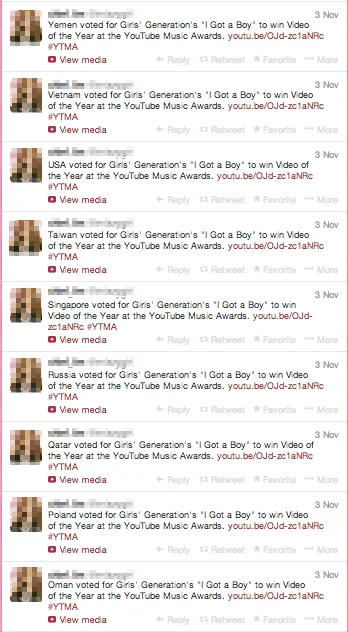
The victory was not a result of chance but rather a highly coordinated international campaign by the SNSD fandom. Observers and participants noted that the voting process was treated with the precision of a political campaign. Because the award was determined by social shares, SONEs organized "relay sessions" to ensure that voting remained constant 24 hours a day.
These relays were managed by fan leaders in different time zones. When fans in South Korea and Japan went to sleep, fans in Europe and North America took over the digital workload. This ensured a steady stream of "I Got a Boy" links flooding social media platforms. Furthermore, reports surfaced of fans utilizing multiple accounts and devices to maximize their output. The use of varied digital identities—ranging from humorous pseudonyms to accounts registered in various geographic regions—demonstrated a level of digital literacy and dedication that characterizes modern K-pop fandoms.
This "power voting" phenomenon has since become a standard practice in the industry, but in 2013, it served as a wake-up call to Western music executives regarding the power of a concentrated, globalized audience. While some critics argued that this method skewed the results away from "general popularity," proponents argued that the awards were designed to celebrate the most engaged communities on YouTube, a metric SNSD indisputably led.
Cultural Friction and the Social Media Aftermath
The announcement of Girls’ Generation as the winner triggered a significant wave of backlash on social media, particularly on Twitter. Many fans of the Western nominees expressed frustration, often rooted in a lack of familiarity with the South Korean music industry. The hashtag "Who is Girls’ Generation?" trended briefly, accompanied by a range of reactions from mild curiosity to xenophobic vitriol.
Some Western fans questioned the legitimacy of the award, suggesting that the win was a "fluke" or the result of "bots." However, music industry analysts pointed out that the metrics used by YouTube were transparent and that the K-pop model had long prioritized digital engagement as a primary means of international expansion. The tension highlighted a growing divide between the traditional Western-centric view of "mainstream" music and the reality of a globalized, internet-driven marketplace where Asian artists could command massive influence without traditional US radio support.
In response to the backlash, the K-pop community and various music critics defended the win, citing Girls’ Generation’s extensive discography, their status as "The Nation’s Girl Group" in South Korea, and the high production value of the "I Got a Boy" music video. The video itself was praised for its experimental structure, blending multiple genres including electro-pop, hip-hop, and dubstep, which was seen as a forward-thinking approach to pop music production.
Strategic Implications for SM Entertainment and the US Market
For SM Entertainment, the agency behind Girls’ Generation, the YTMA win was a validation of their long-term "Cultural Technology" strategy. This strategy involves the systematic training of artists and the localization of content to appeal to diverse global markets. Prior to the 2013 win, Girls’ Generation had already made inroads into the United States, appearing on The Late Show with David Letterman and Live! with Kelly in 2012 to promote the English version of their hit "The Boys."
The YTMA victory provided a second wave of momentum for their American aspirations. It confirmed that there was a viable, hungry audience for their content in the West, even if it remained outside the traditional Top 40 radio circuit. Following the award, there was increased speculation regarding the group’s partnership with Interscope Records and whether a full-scale US debut was imminent. While a sustained, permanent presence in the US market proved difficult to maintain due to the group’s massive commitments in Asia, the win paved the way for future K-pop acts like BTS and Blackpink to be taken seriously by American award shows and media outlets.
Timeline of Key Events Surrounding the Win
- January 1, 2013: Girls’ Generation releases "I Got a Boy," which immediately goes viral for its complex structure and vibrant aesthetic.
- October 2013: YouTube announces the nominees for the first YouTube Music Awards, including Girls’ Generation in the Video of the Year category.
- October 21 – November 3, 2013: The voting period sees intense activity from global fandoms, with SNSD fans utilizing social media sharing to boost the group’s standing.
- November 3, 2013: The awards ceremony is held in New York. Tiffany accepts the Video of the Year award on behalf of the group.
- November 4, 2013: International news outlets, including CNN and the Wall Street Journal, report on the "upset" victory, bringing K-pop into the broader cultural conversation.
- Late 2013: "I Got a Boy" sees a resurgence in digital sales and views following the award ceremony.
Broader Impact on the Global Music Industry
The 2013 YouTube Music Awards served as a precursor to the modern era of music consumption, where social media engagement and streaming data often outweigh traditional sales. Girls’ Generation’s win was a proof-of-concept for the idea that a non-English speaking act could dominate a major Western award through the sheer force of digital community organization.
Furthermore, the event forced a re-evaluation of how "popularity" is measured. The fact that a group from South Korea could outperform the biggest names in American pop indicated that the "mainstream" was no longer a monolithic entity controlled by Western gatekeepers. Instead, it had become a fragmented, globalized landscape where passion and digital strategy could elevate artists to the top of the charts regardless of their geographic origin.
In the years following the win, Girls’ Generation continued to be a dominant force in Asia, while the K-pop industry as a whole began to see more frequent nominations and wins at major Western ceremonies. The 2013 YTMA remains a landmark moment in music history—a point where the digital potential of Hallyu was realized on a global stage, proving that the success of K-pop was not a temporary trend, but a fundamental shift in the global cultural order.
Related News