Baby-Faced Actor Shed His Image With Graphic Sex-Scene In K-Drama
Article Editorial Team

The premiere episode of Netflix’s original K-Drama A Killer Paradox, also known as Murder DIEary, unexpectedly presented viewers with a provocative scene involving lead actor Choi Woo Shik, generating considerable buzz and discussion across social media platforms. The black comedy-thriller, an adaptation of Kkomabi’s popular Naver Webtoon of the same name, immediately set a precedent for its dark and psychologically complex narrative, challenging audience expectations, particularly concerning the established public image of its acclaimed star.
Unpacking the Premise: A Dive into ‘A Killer Paradox’

A Killer Paradox centers on the unlikely journey of Lee Tang (played by Choi Woo Shik), a seemingly ordinary college student whose life takes a drastic turn after an accidental killing. The incident, initially perceived as self-defense, leads him down a path where he discovers a peculiar ability: he can instinctively identify individuals who have committed heinous crimes, often evading justice. This realization transforms him from a guilt-ridden accidental killer into a vigilante, targeting those he believes deserve punishment. His actions, however, draw the attention of Jang Nan Gam (played by Son Suk Ku), a shrewd and relentless detective who becomes entangled in a high-stakes cat-and-mouse chase, determined to bring Lee Tang to justice regardless of his victims’ backgrounds. The series promises a morally ambiguous exploration of crime, punishment, and the elusive nature of justice.
Choi Woo Shik, known for his versatile performances in critically acclaimed projects such as Bong Joon-ho’s Oscar-winning film Parasite and the popular romantic comedy Our Beloved Summer, takes on a role that marks a significant departure from his previous works. His portrayal of Lee Tang requires a nuanced balance between vulnerability, moral confusion, and a burgeoning sense of twisted justice. Son Suk Ku, who has garnered widespread recognition for his intense roles in dramas like My Liberation Notes and the film The Roundup, complements this dynamic as the unwavering detective. The series is directed by Lee Chang-hee, known for his work on the thriller The Vanished and the drama Strangers from Hell, further solidifying the show’s dark and suspenseful undertones.
Episode 1: The Inciting Incident and Its Aftermath

The inaugural episode wastes no time in establishing Lee Tang’s ordinary life and the fateful encounter that upends it. Working a mundane part-time job at a convenience store, Lee Tang encounters two customers whose later actions set the stage for the narrative’s central conflict. Upon leaving work, he finds one of the men, Yeo Bu Il, abandoning his unconscious companion on the street. Confronting Yeo Bu Il, Lee Tang is met with unexpected hostility and a brutal physical assault. Flashbacks to Lee Tang’s past experiences with bullying highlight his deeply ingrained trauma and helplessness.
In a desperate act of self-defense, Lee Tang strikes Yeo Bu Il with a hammer he had borrowed earlier for a minor home repair. The blow proves fatal, plunging Lee Tang into a state of panic and profound guilt. The subsequent scenes meticulously detail his desperate attempts to cover up the crime, showcasing his amateurish and fear-driven actions, which only heighten his anxiety about being discovered and facing legal repercussions for murder.
However, the police investigation takes an unforeseen turn. Detectives, including Jang Nan Gam, initially conclude that the two men had killed each other, possibly due to a dispute stemming from Yeo Bu Il’s affair with his friend’s wife. The investigation then unearths a far more disturbing truth: Yeo Bu Il was not just a victim but a notorious serial killer living under a false identity. His criminal history included murdering a family for insurance money, as well as raping and killing college students before disposing of their bodies.

The Controversial Scene: A Glimpse into Lee Tang’s Psyche
News of Yeo Bu Il’s true identity reaches Lee Tang, offering him a perverse sense of relief and a nascent justification for his actions. The man he killed, he realizes, was not innocent but a perpetrator of unspeakable evils. This revelation, while offering a semblance of solace, does not fully alleviate his internal turmoil.
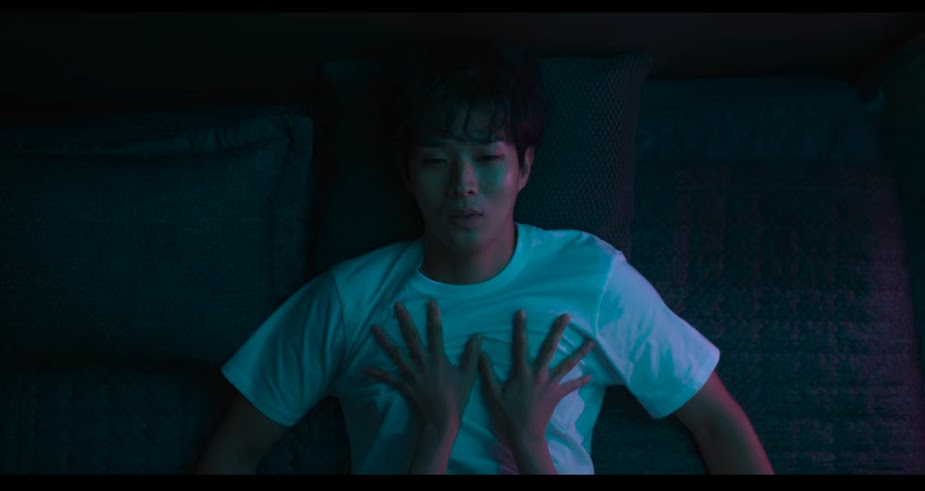
Following a drinking session with a friend, Lee Tang returns to his apartment, where he experiences what appears to be a vivid hallucination or a dream-like sequence. He finds himself in bed with a naked woman on top of him, engaged in what is portrayed as a "sex scene." However, the scene is markedly devoid of passion or intimacy. Lee Tang lies seemingly disconnected, half-clothed, his expression vacant. The woman’s presence, though physically intimate, fails to provide any emotional comfort or distraction from his recent trauma.

A disembodied voice, presumably Lee Tang’s subconscious or a manifestation of his guilt, questions his motives: "Are you consoling yourself, knowing that it was a bad man that you killed? How cunning the human heart is, right?" This internal dialogue underscores his ongoing struggle with guilt and self-justification. The woman then vanishes, replaced by the ghostly apparition of Yeo Bu Il, haunting Lee Tang’s conscience.
In a powerful internal retort, Lee Tang confronts this apparition, mentally listing Yeo Bu Il’s horrific crimes: "You murdered a family for their insurance money and hid in a mountain. You raped and killed college students on a hike and dumped their bodies. And you say what?" He then visualizes Yeo Bu Il’s numerous victims, re-enacting the killing of Yeo Bu Il in his mind, not out of fear, but as an act of posthumous vengeance on behalf of the innocent. This sequence serves as a pivotal moment, illustrating Lee Tang’s fractured psychological state and the nascent development of his vigilante complex.
Viewer Reactions and Thematic Significance

The graphic nature and thematic implications of this scene, appearing so early in the series, took many viewers by surprise. Social media platforms immediately lit up with discussions, with many netizens expressing shock at seeing Choi Woo Shik in such an unconventional and explicit context. The unexpectedness stemmed not just from the visual content but also from the actor’s typically wholesome and boy-next-door image. Many described the scene as "unsexy" or "disconnected," which, far from being a flaw, was likely a deliberate directorial choice.
This "unsexy" portrayal of intimacy is crucial to the show’s narrative. It deliberately subverts typical K-Drama tropes, where intimate scenes are often romanticized or suggestive rather than overtly explicit and emotionally sterile. For Lee Tang, the encounter is not about pleasure or connection but a futile attempt to escape the psychological burden of his actions. The immediate transition from the physical act to the haunting presence of Yeo Bu Il vividly illustrates his inability to find peace or distraction, highlighting his profound moral and psychological distress. It serves as a stark metaphor for his internal battle, where external stimuli cannot assuage his deep-seated guilt and the burgeoning awareness of his ‘gift’ to identify evil.
Choi Woo Shik’s Evolving Image and K-Drama’s Mature Turn
Choi Woo Shik’s decision to take on a role with such dark and mature themes, and to participate in a scene of this nature, speaks volumes about his artistic growth and desire to challenge audience perceptions. Having built a career on nuanced performances that often explore vulnerability and relatable human experiences, A Killer Paradox allows him to delve into the darker facets of human morality. This scene, in particular, showcases his commitment to embodying Lee Tang’s complex psychological state, rather than shying away from uncomfortable realities.
The inclusion of such a scene also reflects a broader trend in K-Drama production, particularly for global streaming platforms like Netflix. While traditional South Korean television dramas often adhere to stricter censorship guidelines, Netflix originals enjoy greater creative freedom, allowing for more mature themes, darker narratives, and explicit content. This shift caters to a global audience increasingly appreciative of K-Content’s diverse storytelling capabilities, from lighthearted romances to gritty thrillers and complex psychological dramas.
Netflix’s substantial investment in K-Content, estimated to be over $2.5 billion since 2016, has facilitated the production of a wide array of genre-bending series that push boundaries. Shows like Squid Game, Hellbound, and The Glory have demonstrated the global appetite for K-Dramas that tackle challenging subjects with artistic integrity and often graphic realism. A Killer Paradox fits squarely within this evolving landscape, leveraging the platform’s reach to tell a story that might face greater restrictions on domestic networks.

Beyond the Initial Shock: The Shower Scene and Physicality
Interestingly, the article also notes that while the initial sex scene was brief and primarily psychological, Choi Woo Shik later surprised viewers with a shirtless shower scene. This subsequent scene, rather than being explicitly sexual, reportedly showcased his "muscular physique," leading to further discussions about the actor’s physical transformation for the role. This contrast further highlights the intentionality behind the first scene’s "unsexy" depiction, suggesting that the show uses physicality not merely for titillation but to explore character development and narrative themes. The shower scene might represent a different facet of Lee Tang’s journey – perhaps a moment of self-reflection, cleansing, or even a growing confidence in his new identity as a ‘purifier’ of evil.
Broader Implications and The Future of K-Content

The discourse surrounding A Killer Paradox‘s opening episode underscores several important implications. For actors, it signifies an increasing opportunity to explore diverse and challenging roles, moving beyond established comfort zones and showcasing greater versatility. For content creators, it affirms the artistic freedom afforded by global streaming platforms, enabling them to adapt source material with greater fidelity and explore complex themes without undue constraint.
For the audience, it signals a maturing K-Drama landscape that is unafraid to tackle morally ambiguous characters and difficult subject matter. The "paradox" in the title is not just central to Lee Tang’s character but also reflects the show’s willingness to make viewers confront uncomfortable truths about justice, morality, and the human psyche. The initial shock gives way to a deeper appreciation for the narrative’s daring choices and its exploration of vigilante justice from a distinctly Korean perspective, building on the legacy of webtoon adaptations that often delve into darker, more intricate storylines. As A Killer Paradox continues its run, it is poised to further cement K-Drama’s reputation for innovative and thought-provoking storytelling on the global stage.
Related News