
The multinational girl group KATSEYE, a collaborative project between K-Pop giant HYBE and American label Geffen Records, is once again at the center of a heated debate concerning the perceived sexualization of its members. Formed through the highly publicized Dream Academy global competition, the group has repeatedly faced intense scrutiny over its concepts, styling, and choreography, with critics arguing that their mature image is deeply problematic, particularly given their young fanbase and the age of the members themselves. The latest controversy surrounding their new track, "Hootie Frutti," has reignited accusations of exploitation and irresponsible artistic direction, prompting a broader discussion about ethical practices in the global pop music industry.
The Genesis of KATSEYE: Ambition Meets Global Reach

KATSEYE emerged from the ambitious Dream Academy survival show, a global audition program launched by HYBE, the powerhouse behind BTS, and Geffen Records, a Universal Music Group imprint. The competition, which concluded in late 2023, aimed to create a truly global girl group, transcending geographical and cultural boundaries by selecting members from diverse backgrounds. The six finalists – Sophia, Lara, Megan, Daniela, Manon, and Yoonchae – were announced to great fanfare, promising a new era of global pop. Their debut, often cited as early 2025, was highly anticipated, with both companies touting KATSEYE as a group designed for international appeal, blending K-Pop’s rigorous training and polished aesthetics with Western pop sensibilities. The vision was clear: to create a phenomenon that could resonate from Seoul to Los Angeles and beyond. However, even from their initial releases, a consistent theme began to overshadow their musical achievements: a recurring pattern of concepts that many observers, including a significant portion of their own burgeoning fanbase, deemed overtly sexualized.
Escalating Concerns: The "Gnarly" Era and the Kids’ Choice Awards Fiasco
The first major wave of public backlash crystallized around KATSEYE’s single "Gnarly," released in the first half of 2026. The track, accompanied by a music video and live performances, featured tight, revealing outfits and provocative dance moves, including elements of twerking. While sensual concepts are not entirely unprecedented in K-Pop, the criticism for "Gnarly" reached a fever pitch due to a specific revelation: a producer later confirmed that background audio in the track was sampled from pornography. This detail alone sparked outrage, but the controversy was dramatically amplified when the group performed "Gnarly" at the Kids’ Choice Awards.

The decision to feature a performance with such mature undertones and a demonstrably problematic audio sample at an event primarily aimed at a young, pre-teen audience sent shockwaves through the fan community and industry observers alike. Social media platforms immediately erupted with condemnations. Critics questioned the judgment of both HYBE and Geffen Records in allowing such a performance, arguing it demonstrated a severe disconnect between the group’s concept and the demographic of its actual viewership. The incident cast a long shadow over KATSEYE’s image, cementing in many minds the perception that the group was being steered in an inappropriate direction. The stark contrast between the target audience of the awards show and the suggestive nature of the performance highlighted what many saw as an ethical lapse on the part of the management companies.
The Persistent Pattern: "Hootie Frutti" and Renewed Outcry
Despite the significant backlash from the "Gnarly" era, KATSEYE’s creative direction appears to have remained largely unchanged. Most recently, the group released "Hootie Frutti" as part of their EP WILD. The music video for "Hootie Frutti" has reignited the same criticisms, showcasing what many describe as overtly sexy choreography and camera work that heavily emphasizes the members’ bodies, often cropping out their faces. This particular visual approach, focusing on specific body parts rather than the artists as whole performers, has been a recurring point of contention, suggesting a deliberate intent to objectify.
Observers noted that "Hootie Frutti" continues a trend of suggestive lyrical or sonic elements, often juxtaposed with high-pitched or "baby-like" vocal deliveries. This jarring combination creates what critics describe as a disquieting blend of supposed innocence and adult suggestion, further blurring lines in a way that many find unsettling. The consistent choice to lean into these mature themes, from revealing styling to provocative movements, has led to a growing frustration among fans who believe that HYBE is mismanaging KATSEYE’s potential and squandering the members’ genuine talent. The visual cues, particularly the camera’s gaze, in "Hootie Frutti" seem to affirm a pattern rather than an isolated artistic choice, prompting renewed calls for accountability from the agencies involved.
The Crucial Age Factor: Yoonchae and the Young Fanbase
Central to the ongoing debate are two critical issues: the age of KATSEYE’s members and the demographic makeup of their dedicated fanbase. Yoonchae, the group’s youngest member, is currently 18 years old. This means that during several of KATSEYE’s earlier controversial releases, including "Gnarly," she was still a minor. While stylists have often dressed her more modestly than her bandmates, opting for comparatively less revealing pieces, she has consistently participated fully in the same choreography, concepts, and promotional imagery. This includes the recent "Hootie Frutti" visuals, where her participation in the suggestive movements, regardless of her individual styling, remains a focal point of concern.

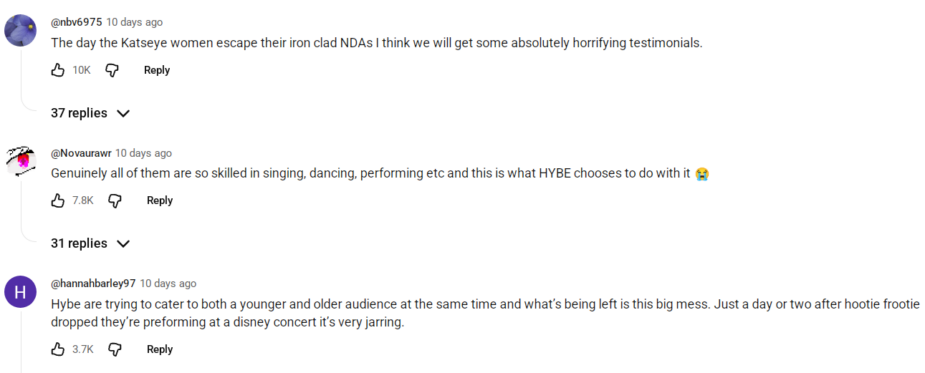
The issue is further compounded by KATSEYE’s audience, which has cultivated a significant following among teenagers and younger fans. This demographic is highly impressionable, and many critics argue that exposing them to overtly sexualized content featuring artists who are themselves very young (or were minors at the time of concept creation) is irresponsible. The prevailing sentiment among these critics is that HYBE and Geffen are attempting to cater to two vastly different audiences simultaneously: a mature, adult audience potentially interested in suggestive concepts, and a young, often child-aged fanbase drawn to the aspirational and energetic aspects of pop music. This dual targeting is seen as inherently problematic, creating an environment where young fans are inadvertently exposed to content that is not age-appropriate.
Public Outcry and Grave Accusations
The release of "Hootie Frutti" and its accompanying visuals led to an immediate resurgence of public outcry across social media and online forums. Fans and pop culture commentators alike voiced their concerns, with many directly quoting or referencing the headline, "Everyone who made KATSEYE is going to hell (except KATSEYE)." This stark statement encapsulates the widespread belief that the members themselves are victims of a system, rather than willing participants in their controversial image.

Tweets and YouTube comments flooded platforms, articulating profound discomfort. One user, @chelslaysss, expressed, "ngl i would gag if this were anyone else but katseye. ik their thing is over-sexualization and skimpy outfits but their audience mainly consists of 12 year olds." Another, @M4INTHINGS, explicitly stated, "the literal children in the audience is why hybe’s over sexualization of katseye is problematic." A third, @bewitchcadence, echoed, "the hyper sexualization of these girls needs to be studied. SIS katseye come back to me." These comments reflect a strong consensus that the group’s direction is inappropriate for its primary demographic.
More disturbingly, some fans have escalated their accusations, going so far as to use the term "grooming." This severe allegation stems from the belief that the consistent push of mature, party-centric sensuality towards a very young and impressionable fanbase, coupled with the youth of the members themselves, constitutes a form of psychological manipulation or exploitation. Such accusations underscore the depth of public anger and the ethical gravity of the situation, moving beyond simple artistic criticism to questions of child protection and corporate responsibility. The concern is that the "polished, aspirational package" that makes the group appealing to young fans is being used as a vehicle to push adult boundaries in an "insidious" manner.
Industry Context and Ethical Dilemmas in K-Pop

The controversy surrounding KATSEYE is not entirely isolated but rather fits into a broader, ongoing discussion within the K-Pop industry and global entertainment regarding the portrayal of young artists. While K-Pop is celebrated for its rigorous training systems, high production values, and synchronized performances, it has also faced criticism for its demanding environment and the age at which idols debut. Many trainees begin their journey in their early teens, and debuts as minors are common. This raises inherent ethical dilemmas for entertainment companies, who must balance artistic expression with the moral imperative to protect their young artists and their young audiences.
The concept of "sexy" or "mature" themes in K-Pop has a long and complex history. While some argue that it can be an empowering form of artistic expression for adult artists, the line becomes blurred when minors or young adults with primarily young fanbases are involved. The global nature of KATSEYE further complicates this, as cultural norms around age-appropriateness can vary significantly. HYBE and Geffen Records, as major players in the global music scene, are expected to uphold high ethical standards, particularly given their influence and the vulnerability of the artists under their management. The alleged use of pornography samples and the specific camera work focusing on bodies rather than faces also raise questions about objectification versus empowerment.
Implications for KATSEYE, HYBE, and Geffen Records

The ongoing controversy poses significant challenges for KATSEYE’s future, as well as for the reputations of HYBE and Geffen Records. For the group members themselves, constant public scrutiny over their image, rather than their talent, can be psychologically taxing and may hinder their artistic development. It risks alienating a significant portion of their potential fanbase and solidifying a problematic image that could be difficult to shake off in the long term.
For HYBE and Geffen, the implications are considerable. Their reputations as responsible entertainment companies are at stake. Investor confidence, public trust, and their ability to attract future talent could be impacted if the accusations of exploitation are not adequately addressed. The lack of a comprehensive public statement from either company regarding the persistent criticisms has only fueled public frustration, suggesting either an unawareness of the severity of the issue or an unwillingness to directly confront it. Navigating the delicate balance between creative freedom, market appeal, and ethical responsibility is a monumental task, and the KATSEYE situation highlights how easily that balance can be perceived as lost. The accusations of "grooming," while coming from fans, are serious enough to warrant a robust and transparent response from management.
A Call for Dialogue and Industry Introspection

The KATSEYE controversy serves as a stark reminder of the evolving landscape of global pop music and the increasing demand for ethical considerations in artist development and concept creation. As the industry continues to globalize and reach younger audiences, the responsibility of entertainment companies to safeguard their artists and cultivate healthy fan environments becomes paramount. The widespread debate calls for more than just a change in concept; it demands introspection from the industry at large about the boundaries of artistic expression, the protection of minors in entertainment, and the ethical responsibilities that come with shaping popular culture for millions of young people worldwide. Without a clear commitment to addressing these deeply rooted concerns, groups like KATSEYE risk being defined by their controversies rather than their artistry, and the industry risks losing the trust of both its artists and its audience. The path forward for KATSEYE, HYBE, and Geffen Records will undoubtedly require a significant re-evaluation of their current strategy and a more transparent engagement with the concerns raised by fans and critics alike.