The inaugural YouTube Music Awards, held at Pier 36 in New York City, concluded with a result that reverberated across the global music industry: South Korean girl group Girls’ Generation secured the coveted Video of the Year award for their hit single "I Got A Boy." This victory, achieved against a field of established Western heavyweights including Justin Bieber, Miley Cyrus, Lady Gaga, and One Direction, serves as a definitive marker of the changing tides in digital music consumption and the formidable power of organized international fandoms. While the win was met with a mixture of surprise and, in some corners, hostility from Western audiences, a closer examination of the data, voting mechanisms, and the group’s historical trajectory reveals that the outcome was the logical result of a highly sophisticated digital campaign.
The Mechanics of the Victory: Engagement Over Raw Statistics
The YouTube Music Awards (YTMA) sought to differentiate themselves from traditional ceremonies like the Grammys or the MTV Video Music Awards by centering their criteria on digital engagement. Rather than relying on a closed panel of industry experts or simple television ratings, the Video of the Year winner was determined by how many times a nominated video was shared across social media platforms, specifically Twitter, Facebook, and Google+.
This metric favored artists with highly active, digitally native fanbases. Girls’ Generation’s "I Got A Boy," released on January 1, 2013, was already a viral sensation within the K-pop sphere before the nominations were announced. By the time of the awards ceremony in November, the video had amassed tens of millions of views, but more importantly, it had become a focal point for social media interaction. The "share-to-vote" system effectively turned the awards into a test of fandom mobilization. For the group’s dedicated fanbase, known as Sones, the voting period was treated with the precision of a military operation.
Fandom Mobilization and the "Relay" Voting System
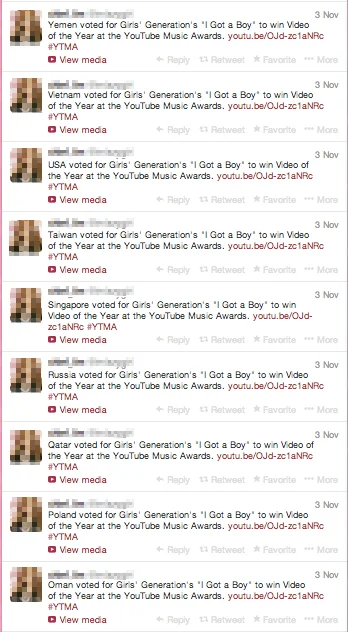
The victory of Girls’ Generation was not a result of passive viewership but rather a deliberate, coordinated effort by a global network of fans. Throughout the voting period, social media timelines were flooded with standardized posts designed to register as votes. Reports from within the fandom community indicated the use of "relay sessions," where fanbases in different time zones took turns leading the voting charge to ensure 24-hour momentum.
This systematic approach involved fans utilizing multiple devices and accounts to maximize the group’s reach. On platforms like Twitter, it was common to see fans from diverse geographical locations—ranging from Southeast Asia to the United States and Europe—engaging in synchronized sharing bursts. This level of organization highlights a broader trend in K-pop culture, where the success of an artist is viewed as a collective achievement for the fandom. The sheer volume of shares for "I Got A Boy" overwhelmed the social media presence of Western pop stars, whose fans, while numerous, lacked the same level of centralized coordination for this specific award format.
Chronology of the "I Got A Boy" Phenomenon
To understand the weight of the YTMA win, one must look at the timeline of the "I Got A Boy" release and its subsequent impact on the charts:
- January 1, 2013: "I Got A Boy" is released as the title track of Girls’ Generation’s fourth Korean studio album. The song, an experimental mashup of hip-hop, electronic dance music, and bubblegum pop, receives polarized reviews but immediate viral attention.
- January 4, 2013: The music video surpasses 10 million views on YouTube in just 55 hours, setting a record for the fastest K-pop group video to reach that milestone at the time.
- Early 2013: The song dominates South Korean music charts, including the Gaon Digital Chart and the Billboard K-Pop Hot 100.
- October 2013: YouTube announces the nominations for the first-ever YouTube Music Awards. Girls’ Generation is nominated for Video of the Year alongside global icons.
- November 3, 2013: Tiffany Hwang, representing Girls’ Generation, accepts the Video of the Year award in New York City.
- Post-Award Period: The win triggers a massive spike in searches for "Girls’ Generation" and "K-pop" globally, while also sparking a debate about the legitimacy of social-media-driven awards.
Reaction and Cultural Friction in the Western Market
The announcement of Girls’ Generation as the winner was met with immediate and often intense backlash from fans of the defeated Western nominees. On social media, the phrase "Who is Girls’ Generation?" trended, often accompanied by xenophobic or dismissive comments. This reaction underscored the "bubble" effect of Western mainstream music culture, which had largely remained insulated from the massive growth of the Hallyu (Korean Wave) until the breakthrough of Psy’s "Gangnam Style" in 2012.
The tension between K-pop fans and Western pop enthusiasts revealed a fundamental misunderstanding of the global music landscape. While "I Got A Boy" may not have had the same level of American radio airplay as Miley Cyrus’s "We Can’t Stop" or Justin Bieber’s "Beauty and a Beat," its digital footprint was undeniably larger during the specific window of the YTMA voting. The win forced the industry to acknowledge that "mainstream" is no longer defined solely by Western charts, but by global digital activity.
A Fact-Based Analysis of the "I Got A Boy" Video
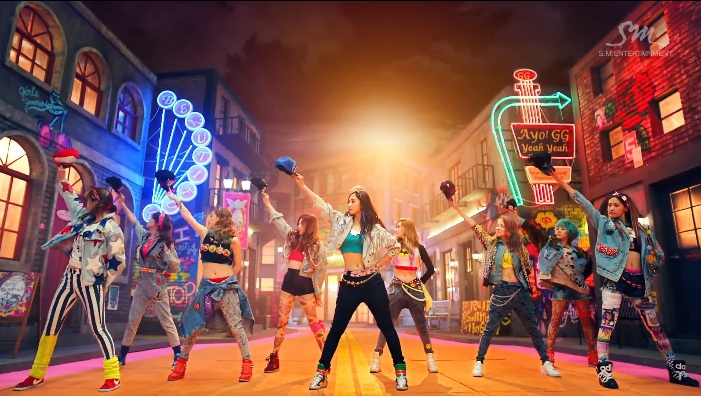
Critically, "I Got A Boy" was a strong contender for Video of the Year not just because of the fans, but because of its production value. Directed by Seo Hyun-seung, the video featured rapid-fire costume changes, intricate choreography, and a multi-segmented narrative structure that mirrored the song’s unconventional tempo changes. At a time when YouTube was becoming the primary platform for music discovery, the visual complexity of the video made it highly re-watchable and shareable—qualities that were directly rewarded by the YTMA algorithm.
Furthermore, the video’s aesthetic—a blend of "street" fashion and high-concept pop—appealed to a wide demographic across Asia and the growing K-pop niche in the West. SM Entertainment, the group’s management agency, had intentionally designed the comeback to have a more global, edgy appeal compared to the group’s previous "innocent" or "uniform-based" concepts.
Implications for the Future of K-Pop and US Expansion
The YTMA victory raised significant questions regarding the group’s future in the United States. Following the win, industry analysts speculated on whether SM Entertainment would double down on American promotions. The group had already signed with Interscope Records for their English-language release "The Boys" in 2011 and had appeared on major U.S. talk shows like The Late Show with David Letterman.
However, the YTMA win proved that a group could achieve "worldwide" presence and dominate a major American-hosted award show without necessarily following the traditional path of a full-scale U.S. debut. It demonstrated that the digital space had bypassed traditional gatekeepers like FM radio and cable television. For Girls’ Generation, the award was a validation of their longevity. Having debuted in 2007, they had survived the transition from the physical CD era to the digital streaming era, maintaining a dominant position in the industry for over six years—a rarity for girl groups in the fast-paced South Korean market.
The Broader Impact on the Music Industry
The success of Girls’ Generation at the 2013 YTMAs served as a precursor to the eventual global explosion of groups like BTS and BLACKPINK. It proved that the "K-pop model"—characterized by high-budget visual content, intensive fan engagement, and strategic use of social media—was perfectly suited for the 21st-century music economy.
The event also forced award shows to reconsider their voting structures. While the YTMAs were criticized for being a "popularity contest" dominated by organized fanbases, they were also praised for accurately reflecting the reality of how young people consume and share music. The data showed that engagement is a more potent currency than passive listening.
In conclusion, the Video of the Year win for Girls’ Generation was not a fluke or a statistical anomaly. It was the result of a perfectly executed digital strategy by a global fanbase, supported by a high-quality creative product from SM Entertainment. While the win challenged the sensibilities of the Western music establishment, it provided an early glimpse into a future where geographical borders and language barriers are increasingly irrelevant in the face of digital connectivity. The victory did more than just add a trophy to the group’s mantle; it solidified K-pop’s seat at the table of global mainstream culture.