
The Recording Academy has officially introduced several significant changes to its category structure for the upcoming 69th Annual GRAMMY Awards, most notably the creation of the Best Asian Pop Music Performance category. While the Academy framed the addition as a move toward greater inclusivity and global representation, the decision has immediately ignited a firestorm of controversy among music industry analysts and global fanbases. Critics argue that the move effectively "ghettoizes" Asian artists, potentially serving as a barrier to their success in the prestigious "Big Four" general field categories: Album of the Year, Record of the Year, Song of the Year, and Best New Artist.
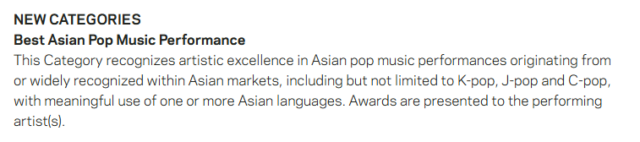
According to the official guidelines released by the Recording Academy, the Best Asian Pop Music Performance category is designed to recognize "artistic excellence in Asian pop music performances originating from or widely recognized within Asian markets." The criteria specifically mention genres such as K-pop, J-pop, and C-pop, and stipulate that eligible recordings must feature the "meaningful use of one or more Asian languages." The awards are intended to be presented to the performing artists, acknowledging their cultural and commercial impact on a global scale.
The Context of Category Expansion
This move follows a recent trend within the Recording Academy to create region-specific or genre-specific categories for rapidly expanding global music markets. In the previous year, the Academy introduced the Best African Music Performance category, which was met with a mix of praise for recognizing the continent’s diverse sounds and skepticism regarding the separation of African artists from the general pop field. The addition of an Asian-specific category appears to be a continuation of this strategy, intended to modernize the awards to reflect the 21st-century music landscape where non-Western music dominates global charts.
However, the timing and execution of this announcement have led to intense scrutiny. For years, the Recording Academy has faced allegations of xenophobia and Western-centric bias. Despite the unprecedented global success of groups like BTS, BLACKPINK, and SEVENTEEN, Asian artists have historically struggled to secure nominations in the major categories. When nominations have occurred—such as BTS’s three-year streak of nominations in the Best Pop Duo/Group Performance category—wins have remained elusive, leading many to believe the Academy is hesitant to fully integrate international acts into its core honors.
Analysis of the Criteria and Language Requirements
The specific requirement for "meaningful use of one or more Asian languages" is a focal point of the current debate. On one hand, this ensures that the category celebrates the cultural heritage and linguistic diversity of Asian music. On the other hand, it raises questions about the eligibility of Asian artists who release music entirely in English to appeal to a broader international audience.

In recent years, several K-pop acts have released English-language singles that topped the Billboard Hot 100, such as BTS’s "Dynamite" and "Butter." Under the new rules, such tracks might not qualify for the Best Asian Pop Music Performance category, potentially leaving them to compete in the highly crowded General Pop categories where they have historically faced an uphill battle. Conversely, if an artist releases a track in Korean or Japanese, critics fear the Academy’s voting body—which is still predominantly North American—will reflexively pigeonhole the entry into the "Asian Pop" category rather than considering it for Record of the Year or Song of the Year.
Global Market Trends and the Growth of Asian Music
The Recording Academy’s decision comes at a time when Asian music markets are experiencing explosive growth. According to the IFPI (International Federation of the Phonographic Industry) Global Music Report 2023, the Asian music market grew by 14.9%, outpacing the global average. South Korea, in particular, has seen its music exports reach record highs, with K-pop becoming a multi-billion dollar industry.
The sheer volume of consumption for J-pop (Japan) and the emerging C-pop (China) market further underscores the necessity for the Academy to address these regions. By creating a dedicated category, the Academy argues it provides a platform for artists who might otherwise be overlooked by the 12,000-plus voting members of the Recording Academy. The "Best Asian Pop Music Performance" award could potentially offer a gateway for artists from Thailand, Vietnam, the Philippines, and India to gain visibility on the world’s most prestigious music stage.
Public and Social Media Reaction
The reaction on social media platforms like X (formerly Twitter) and Reddit has been overwhelmingly skeptical. Fans of BTS, known as ARMY, have been particularly vocal, pointing out that the group’s historical impact on the music industry should have already qualified them for major category wins. One viral post suggested that the Academy is "creating a little corner" for Asian artists to inhabit, effectively setting a limit on their potential achievements.
Critics argue that by lumping K-pop, J-pop, and C-pop into a single category, the Academy is ignoring the distinct cultural and musical differences between these genres. "It is a form of lumping disparate cultures into a single ‘othered’ bucket," noted one industry analyst. This sentiment echoes the long-standing criticism of the "World Music" category, which was eventually renamed "Best Global Music Album" in 2020 after the Academy acknowledged that the term "World Music" carried connotations of colonialism and "otherness."
Historical Precedents and the "Glass Ceiling"
The struggle for international and non-white artists at the GRAMMYs is not a new phenomenon. The creation of the Latin GRAMMYs in 2000 was a watershed moment that allowed for the celebration of Spanish and Portuguese-language music, but it also led to concerns that Latin artists were being diverted away from the main GRAMMY ceremony.

In the main awards, the "Big Four" have often been criticized for lack of diversity. Since the inception of the GRAMMYs in 1959, very few non-Western or non-English-speaking artists have won the top prizes. The addition of the Best Asian Pop Music Performance category is seen by some as an admission that the Academy’s voting body is not yet ready to judge Asian pop on the same playing field as Western pop.
The Recording Academy’s Defense
Recording Academy CEO Harvey Mason jr. has frequently defended the organization’s efforts to evolve. In previous statements regarding category changes, Mason jr. has emphasized that the goal is to "accurately represent a wide range of relevant musical genres" and to "stay aligned with the ever-changing musical landscape."
The Academy has also made efforts to diversify its voting membership. In 2023 and 2024, thousands of new members were invited from diverse backgrounds and international territories. The Academy posits that specialized categories allow experts within those specific fields to determine the winners, ensuring that the artists who are truly pushing the boundaries of Asian pop are the ones being recognized, rather than just the most commercially successful ones in the U.S.
Implications for the 69th Annual GRAMMY Awards
As the music industry prepares for the 2027 awards cycle, the inclusion of Best Asian Pop Music Performance will fundamentally change how labels and artists strategize their submissions. For major K-pop agencies like HYBE, SM Entertainment, and JYP Entertainment, the new category presents a dilemma: do they submit their top artists for the "Asian Pop" category to ensure a nomination, or do they push for the general field categories at the risk of being shut out entirely?
Furthermore, the "Asian Pop" category will likely become one of the most competitive fields in the ceremony. With the high output of top-tier talent from across Asia, the five nomination slots will be fiercely contested. This could lead to a situation where globally dominant acts are competing against one another in a sub-category, while the "Best Pop Performance" category remains dominated by American and British acts.
Broader Industry Impact and Future Outlook
The decision to create a Best Asian Pop Music Performance category is a double-edged sword. On a positive note, it guarantees that at least one Asian artist or group will take home a trophy each year, providing a level of visibility that was previously not guaranteed. It also encourages the Recording Academy’s voting members to listen to and evaluate music from Asian markets that they might have previously ignored.
However, the move also highlights the systemic issues within the awards process. If the GRAMMYs are to be truly "global," many argue that categories should be based on genre and artistic merit regardless of the artist’s origin or language. The "Asian Pop" designation implies that the music is inherently different from "Pop," a distinction that many fans and artists reject.
In the coming years, the success or failure of this category will be measured by whether it acts as a stepping stone or a stumbling block. If winners of the Best Asian Pop Music Performance category eventually find themselves nominated for Album of the Year, the Academy’s strategy will be vindicated. If, however, Asian artists remain confined to this new category while being excluded from the night’s biggest honors, the accusations of segregation and xenophobia are likely to persist.
As the 2027 GRAMMY season approaches, the world will be watching to see how the Recording Academy handles this new chapter. The introduction of the Best Asian Pop Music Performance category is more than just a rule update; it is a reflection of the ongoing tension between a traditional Western institution and a rapidly globalizing music industry. Whether this move fosters genuine inclusivity or further isolates international talent remains to be seen, but it has undoubtedly sparked a necessary conversation about the definition of "excellence" in a borderless digital age.