

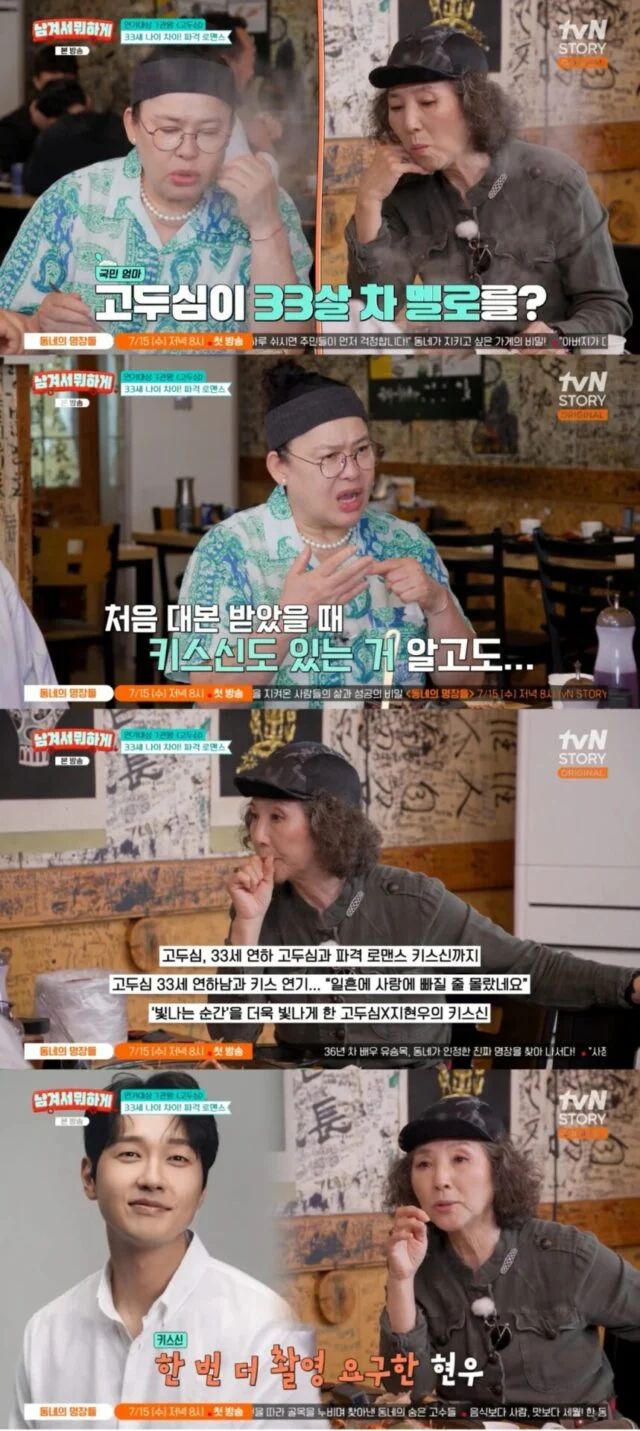
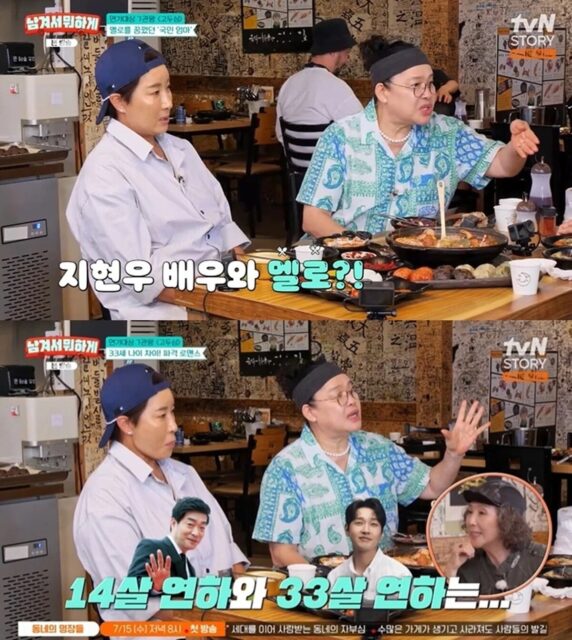
Host Lee Young Ja initiated the conversation by revisiting the public’s reaction to the casting of Everglow. At the time of its release, the film garnered substantial media attention and sparked public debate due to the significant age gap between the two leads. Lee Young Ja noted that from a viewer’s perspective, the pairing was "shocking" and inquired whether Go Doo Shim felt any trepidation or fear regarding how the audience might perceive the unconventional romance. Go Doo Shim, known for her stoic and grounded screen presence, responded with characteristic poise, stating that she did not feel fear when approaching the project. Instead, she viewed the role through the lens of character depth and emotional authenticity rather than focusing on the sensationalist aspects of the age difference.
The Dynamics of the On-Set Collaboration
As the interview progressed, the conversation turned toward the technical and emotional execution of the film’s central romantic moments. Lee Young Ja asked whether Go was aware during the script-reading phase that the story would culminate in a kiss scene with Ji Hyun Woo. Go confirmed that she was fully aware of the scene’s inclusion and admitted to having moments of contemplation regarding how to best approach the performance. She noted that while she initially wondered how the scene would be handled, she ultimately viewed it as an essential component of the narrative arc.
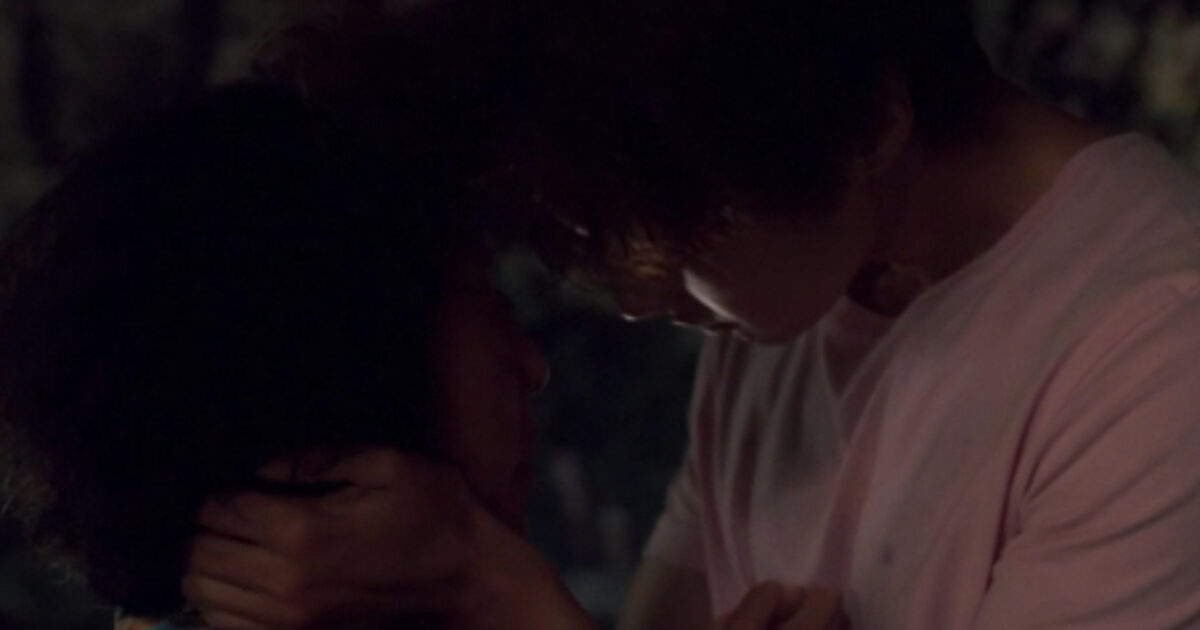
The most notable revelation from the interview occurred when Go Doo Shim recounted the filming of the kiss scene itself. Despite her decades of experience and reputation for professional precision, she revealed that the scene required more than one take—not because of errors on her part, but at the request of her younger co-star. "I don’t think I made any bloopers," Go explained, "but I think Hyun Woo said we should do it one more time." This detail highlighted the dedication of both actors to capturing the specific emotional nuance required for the scene, ensuring that the physical intimacy felt earned and narratively consistent.
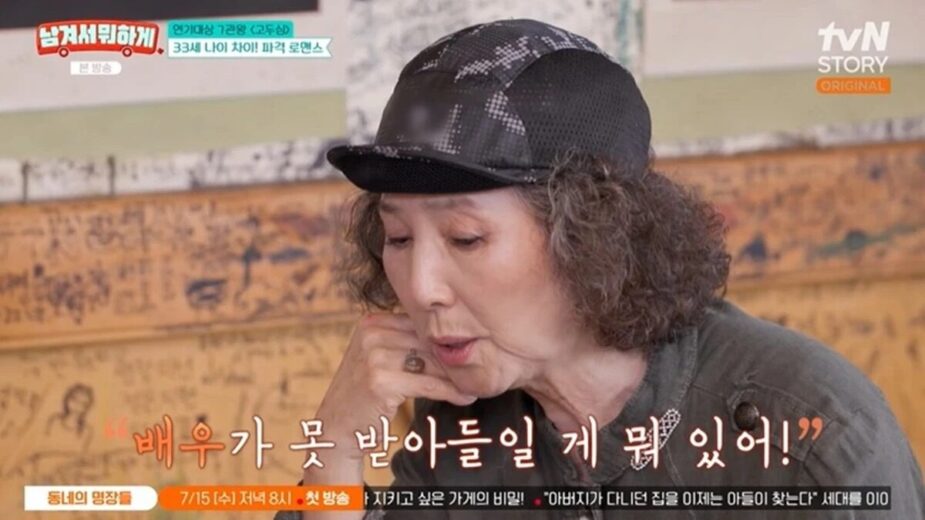
Go Doo Shim emphasized that the kiss was not intended to be provocative or sensational. She argued that the scene was a culmination of the characters’ shared trauma and mutual understanding. In Everglow, Go plays Jin-ok, a veteran haenyeo (traditional sea diver) on Jeju Island, while Ji Hyun Woo portrays Kyung-hoon, a documentary producer who travels to the island to film her. As they spend time together, they find solace in each other’s emotional wounds. Go explained that for her character, the moment was about reclaiming a sense of self that had been buried under decades of hardship. "She was a grandmother, but she was also a woman," Go remarked. "She was someone whose life was pitiful, so it was a scene where those emotions collided. That’s why it didn’t feel strange."
Background and Context: ‘Everglow’ and the Jeju Haenyeo Culture
To understand the weight of Go Doo Shim’s performance, it is necessary to examine the cultural and geographical context of Everglow. The film is deeply rooted in the culture of Jeju Island, Go’s actual birthplace, and focuses on the lives of the haenyeo—women who dive into the ocean to harvest seafood without oxygen tanks. This profession is recognized by UNESCO as an Intangible Cultural Heritage of Humanity and is often associated with strength, resilience, and matriarchal power.

Go Doo Shim, often referred to as the "National Mother" of South Korea due to her frequent portrayals of maternal figures in hit dramas, took a significant risk by stepping into a romantic role at this stage of her career. For decades, the South Korean entertainment industry has largely relegated actresses over the age of 60 to supporting roles as mothers or grandmothers. Everglow broke this mold by centering on the internal life and romantic desires of an older woman. The film’s director, So Joon-moon, sought to explore the "shining moments" of a woman’s life that exist outside of her societal roles as a caregiver.
Ji Hyun Woo’s involvement in the project was equally significant. A former idol and a respected actor known for his roles in "noona romances" (romances involving an older woman and a younger man), Ji’s decision to participate in a film with a 33-year age gap was seen as a bold career move. His request for a retake of the kiss scene, as revealed by Go, suggests a high level of professional respect and a desire to move past the initial awkwardness of the age difference to deliver a performance that felt authentic to the characters’ connection.
Chronology of the Film’s Impact and Critical Reception
The journey of Everglow from script to screen was marked by both curiosity and skepticism. When the project was first announced in 2020, K-netizens expressed a range of opinions, with some questioning the realism of the romance. However, upon its premiere at the 25th Busan International Film Festival (BIFF) in October 2020, the film began to shift the narrative.
- June 2021: Everglow was officially released in South Korean theaters. Critics praised Go Doo Shim for her raw and vulnerable performance, noting that she successfully transitioned from her "National Mother" persona to a more complex, multi-faceted woman.
- July 2021: Go Doo Shim was awarded the Best Actress award at the 12th Korea Film Reporters Association (KOFRA) Film Awards for her role in the film. The award served as a formal acknowledgment of her bravery in taking on a role that challenged industry norms.
- 2022-2023: The film gained a second life on international streaming platforms, where it was lauded for its cinematography and its sensitive portrayal of grief and healing.
- July 6, 2024: The Waste Not broadcast brought the film back into the spotlight, allowing Go Doo Shim to provide a retrospective look at the production and her working relationship with Ji Hyun Woo.
Analysis of Implications for the Korean Entertainment Industry
The revelation that Ji Hyun Woo sought a retake of the kiss scene, combined with Go Doo Shim’s defense of the scene’s emotional necessity, points to a broader shift in how South Korean media handles aging and intimacy. Historically, Korean dramas and films have adhered to strict beauty standards and age-appropriate pairings. However, the success and critical acclaim of Everglow suggest that audiences are becoming more open to narratives that explore the humanity of older individuals.
The "Ji Hyun Woo retake" anecdote also sheds light on the professional etiquette of modern Korean sets. In an industry where hierarchy is often dictated by age and seniority, for a younger actor to suggest a retake to a veteran of Go Doo Shim’s stature requires a high degree of mutual trust. It indicates that the production environment was one of creative collaboration rather than rigid adherence to seniority.
Furthermore, Go Doo Shim’s participation in the Jeju-themed special of Waste Not reinforces her status as a cultural ambassador for the island. By discussing the film in the context of her home province, she bridges the gap between her personal identity and her professional achievements. The interview serves as a reminder that her career is not merely a collection of roles, but a continuous effort to expand the boundaries of what a veteran actress can achieve.
Broader Societal Impact
The discourse surrounding Everglow touches upon the "invisible" status often afforded to elderly women in East Asian societies. By portraying Jin-ok not just as a worker or a grandmother, but as a person capable of romantic attraction and emotional vulnerability, the film challenges the viewer to reconsider their own biases regarding aging.
Go Doo Shim’s remarks on Waste Not provide a final, clarifying layer to the film’s legacy. By downplaying the "shock" factor and focusing on the "pitiful" and "colliding" emotions of the characters, she reclaims the narrative from tabloid headlines. The request for a retake by Ji Hyun Woo, far from being a scandalous detail, is framed as a testament to the pursuit of artistic excellence. As the Korean film industry continues to evolve, the precedent set by Go Doo Shim and Everglow will likely encourage more diverse storytelling that transcends the limitations of age and traditional casting.
In conclusion, the interview on tvN STORY’s Waste Not was more than just a trip down memory lane; it was a professional affirmation of a landmark piece of cinema. Go Doo Shim’s ability to discuss the intricacies of her work with Ji Hyun Woo with such grace ensures that her legacy remains defined by her craft and her willingness to explore the full spectrum of the human experience.

Leave a Reply