

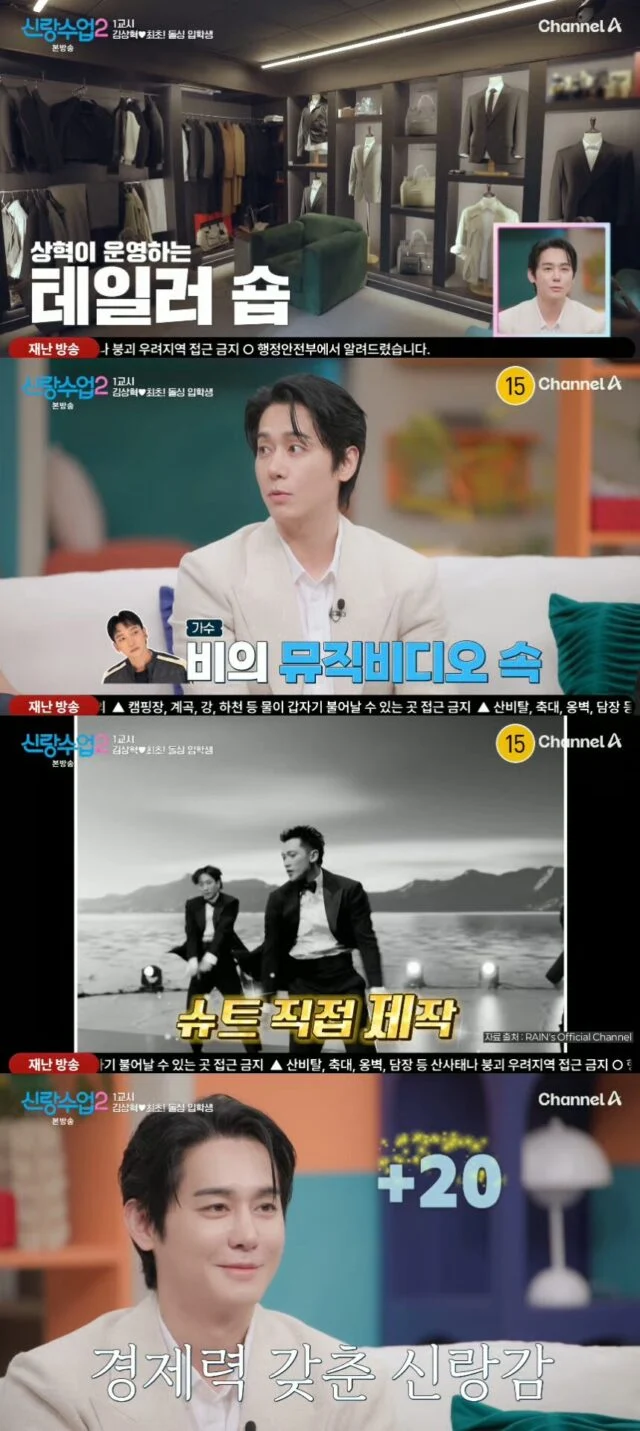
Former Click-B member Kim Sanghyuk has reportedly achieved extraordinary financial success through his entrepreneurial ventures, with his current monthly business revenue surpassing the annual salary of many employees at major South Korean corporations. This revelation, made during his recent appearance on Channel A’s Groom Class Season 2, spotlights a significant career pivot for the idol, who faced a major scandal early in his career and has since quietly built a lucrative life away from the demanding spotlight of K-Pop.
A Remarkable Financial Reversal
On the July 16 episode of Groom Class Season 2, Kim Sanghyuk, making history as the program’s first divorced cast member, offered viewers a rare glimpse into his bustling post-celebrity life. The segment showcased him actively involved in the operations of a tailor shop, a venture where he directly contributes to clothing design. He proudly mentioned having designed a suit worn by global superstar Rain in one of his music videos, underscoring his hands-on approach and design acumen.
However, the tailor shop represents only a fraction of his diverse business portfolio. Kim Sanghyuk further disclosed his forays into other markets, including health patches and bags. The breadth of his entrepreneurial efforts caught the attention of fellow cast members, notably veteran singer Lee Seung Chul, who expressed genuine surprise upon learning that Kim Sanghyuk was the designer behind bags he had already purchased. This anecdote not only highlighted the quality and appeal of Sanghyuk’s products but also illustrated how effectively he has transitioned from a public figure to an astute, behind-the-scenes businessman.
The most striking disclosure came when Kim Sanghyuk was pressed about the financial scale of his enterprises. His candid response—"It basically exceeds the annual salary of someone working at a major corporation"—sent ripples through the studio and subsequently, through the public. This statement implies a monthly revenue stream potentially ranging from ₩70 million to over ₩100 million (approximately $50,000 to $75,000 USD), considering that the average annual salary for mid-to-senior level employees at major South Korean conglomerates like Samsung, LG, or Hyundai often falls within the ₩70 million to ₩120 million range. Such a figure positions his total annual business income potentially well into the high hundreds of millions, or even billions, of Korean Won, a stark contrast to the often-unstable earnings of many entertainment industry professionals.

The Genesis of Ambition: Battling Industry Instability
Kim Sanghyuk attributed his relentless drive for entrepreneurial diversification not merely to ambition but to a profound sense of anxiety stemming from the inherent instability of the entertainment industry. Having personally navigated prolonged periods without celebrity work, he recognized the crucial need to establish a stable financial foundation independent of the fickle nature of fame. This insight offers a poignant commentary on the often-glamorized world of K-Pop, where dazzling success can be fleeting and financial security elusive, even for established stars. Many idols, particularly those from earlier generations or smaller agencies, often face significant financial challenges once their peak popularity wanes or their contracts end, leading to a pressing need for alternative income streams. Kim Sanghyuk’s proactive approach reflects a growing trend among former celebrities to secure their future through business ventures.
Click-B’s Legacy and a Fateful Misstep
To fully appreciate Kim Sanghyuk’s journey, it is essential to revisit his origins. He debuted in 1999 as a member of Click-B, a prominent boy band formed by DSP Media. Click-B was a distinctive group in the first generation of K-Pop, known for their unique blend of rock and dance music. Comprising seven members, they quickly garnered a dedicated fanbase and achieved significant popularity alongside contemporaries like H.O.T., Sechs Kies, and g.o.d. Their hits, such as "Dreaming" and "Cowboy," cemented their place in the burgeoning K-Pop landscape, establishing them as a group with both musical talent and strong visual appeal. For several years, Kim Sanghyuk enjoyed the peak of idol life, performing on major stages, appearing on television, and experiencing the adoration of millions.
However, his career suffered a catastrophic blow in 2005, a turning point that would irrevocably alter his trajectory within the entertainment industry.
The 2005 Scandal: A Career-Altering Event

In a scandal that sent shockwaves through the South Korean entertainment scene, Kim Sanghyuk was involved in a drunk-driving and hit-and-run incident in April 2005. The accusations were severe: he was alleged to have fled the scene after causing a traffic accident, only reporting to the police approximately 11 hours later. The delay in reporting compounded the gravity of the situation, drawing widespread public condemnation.
The legal repercussions were swift and impactful. Kim Sanghyuk was ultimately sentenced to 10 months in prison, suspended for two years, and ordered to complete 120 hours of community service. While he avoided immediate incarceration, the legal judgment marked him as a public figure who had committed a serious offense.
Compounding the crisis, his attempt to mitigate the damage during a subsequent press conference backfired spectacularly. In a statement that quickly became infamous and widely mocked, he attempted to draw a semantic distinction between drinking and driving under the influence. His exact words, often paraphrased, suggested that he "drank, but did not drive while drunk." This statement was perceived by the public as disingenuous and an attempt to evade responsibility, further eroding his public image and trust. The remark became a national meme, an enduring symbol of celebrity gaffes, and followed him relentlessly, significantly hindering his ability to resume entertainment activities for an extended period. The scandal not only derailed his active idol career but also instilled a deep-seated public skepticism that made any potential comeback incredibly challenging.
Navigating the Aftermath: Attempts at Return and a New Path
In the years following the 2005 incident, Kim Sanghyuk made several attempts to return to the public eye, often appearing on variety shows or participating in nostalgic Click-B reunions. While these efforts allowed him brief moments back in the spotlight, the shadow of his past scandal, coupled with the highly competitive and unforgiving nature of the K-Pop industry, made a full-fledged career revival difficult. The public memory in South Korea for such transgressions can be long-lasting, and the entertainment industry often imposes a de facto ban on figures associated with moral controversies.
It was during this period of uncertainty and career stagnation that Kim Sanghyuk evidently began to lay the groundwork for his alternative path. Recognizing the limitations of relying solely on celebrity income, he channeled his energy into developing tangible businesses. This strategic shift, born out of necessity and a desire for stability, has now culminated in the impressive financial independence he revealed on Groom Class Season 2. His story serves as a testament to resilience and adaptation, demonstrating that a career-altering misstep does not necessarily equate to financial ruin, especially for those willing to reinvent themselves.

The Korean Entertainment Industry: A Double-Edged Sword
Kim Sanghyuk’s experience underscores a critical aspect of the Korean entertainment industry: its inherent precarity. While the top-tier idols and actors command immense wealth and influence, the vast majority struggle with financial instability. Idols often debut at a young age, incurring significant training debts to their agencies. Their earnings, particularly in the early stages, can be minimal, with profits often heavily skewed towards the management company. Even successful groups may not see substantial personal income until years into their careers, after debts are repaid and contract terms are renegotiated.
Furthermore, public figures are constantly under scrutiny, and a single misstep, whether personal or professional, can lead to severe career repercussions. Scandals involving drunk driving, drug use, or personal controversies often result in immediate boycotts, contract terminations, and a long-term inability to find work. This intense pressure creates an environment where financial planning and alternative career paths become not just prudent but essential for long-term security. Kim Sanghyuk’s anxiety about an "uncertain future" is a shared sentiment among many in the industry, highlighting the often-hidden struggles behind the glamorous facade.
Entrepreneurship as a Second Act: A Growing Trend Among Celebrities
Kim Sanghyuk is not an isolated case. His successful transition into entrepreneurship reflects a broader trend among South Korean celebrities, particularly those from older generations or those who have faced career setbacks. Many former idols and actors are leveraging their public recognition, business acumen, and often, their personal networks, to establish successful ventures in various sectors.
Examples abound, from food and beverage franchises to fashion lines, beauty brands, and even tech startups. Celebrities like Jessica Jung (former Girls’ Generation), who launched her fashion brand Blanc & Eclare, and Seungri (former BIGBANG), who invested heavily in various businesses before his own scandals, illustrate the allure of entrepreneurship. While Seungri’s story ended tragically, it initially showcased the potential for massive financial gains outside of entertainment. The perceived stability and direct control offered by one’s own business are powerful incentives for those accustomed to the transient nature of fame and the strictures of agency contracts. This trend signifies a maturing entertainment ecosystem where personal brands are increasingly seen as assets that can be diversified and monetized beyond traditional performance roles.

Redemption and Re-evaluation: Public Perception and Second Chances
Kim Sanghyuk’s recent public appearance and the revelation of his business success also invite a re-evaluation of his public image. For years, he was largely remembered for the 2005 scandal and the accompanying PR disaster. His sustained efforts to build a legitimate, thriving business empire away from the demands of celebrity culture could slowly chip away at that negative perception.
In South Korea, public forgiveness for scandals, particularly those involving public safety or moral integrity, is often hard-won. However, a narrative of genuine rehabilitation, hard work, and achieving success through legitimate means can contribute to a gradual shift in public sentiment. His appearance on Groom Class Season 2, a program focused on personal growth and finding love, further supports this potential for a redemption arc. By openly discussing his past struggles and present achievements, he offers a relatable story of overcoming adversity and finding purpose beyond past mistakes. This may not erase the memory of the scandal, but it certainly adds a new, more positive dimension to his public persona.
Future Outlook: Sustaining Success Beyond the Spotlight
The journey of Kim Sanghyuk from a controversial K-Pop idol to a highly successful entrepreneur is a compelling narrative of resilience and strategic reinvention. His ability to build multiple thriving businesses, from bespoke tailoring and fashion accessories to health products, demonstrates a keen understanding of market demands and an unwavering commitment to his new path.
As he continues to balance occasional television appearances with his business endeavors, his story offers a powerful message about the evolving landscape of celebrity in South Korea. It highlights the importance of financial literacy and entrepreneurial spirit for individuals whose careers are subject to the whims of public opinion and the inherent volatility of the entertainment industry. Kim Sanghyuk’s reported monthly revenue, which eclipses the annual earnings of many corporate professionals, stands as a testament to the potential for a fulfilling and prosperous "second act," even after facing significant public setbacks. His success not only secures his own financial future but also serves as an inspiration for others navigating similar transitions, proving that genuine effort and strategic planning can indeed lead to greater prosperity off stage than on it.



Leave a Reply