The intersection of South Korean domestic politics and the globalized K-pop industry reached a unique juncture in 2013 with the release of the single Female President by the girl group Girl’s Day. Coming on the heels of the historic election of Park Geun-hye as the nation’s first female head of state, the song was marketed as an anthem of empowerment. However, the track and its accompanying music video have since become focal points for academic and journalistic critique regarding the superficiality of gender-related progress in South Korea. While the election of a female president was a landmark event for a nation often cited for its deeply entrenched patriarchal structures, the cultural reflection of this milestone in popular media suggested a disconnect between political symbolism and the lived realities of South Korean women.
The Political Context of Park Geun-hye’s Presidency
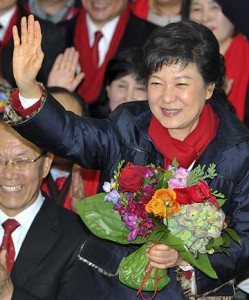
In December 2012, Park Geun-hye, representing the conservative New Frontier Party (Saenuri Party), won the South Korean presidential election by a narrow margin. Her victory was momentous, as she became the first woman to lead a Northeast Asian nation. Park was the daughter of Park Chung-hee, the military leader who ruled South Korea from 1961 until his assassination in 1979. This lineage made her a polarizing figure; while older generations associated her with the rapid economic development of the "Miracle on the Han River," younger and more progressive demographics viewed her through the lens of her father’s authoritarian legacy.
Despite the controversy, her inauguration in February 2013 was framed by many as a potential watershed moment for women’s rights. South Korea has historically struggled with gender equality, consistently ranking at the bottom of the Organisation for Economic Co-operation and Development (OECD) in several key metrics. The presence of a woman in Cheong Wa Dae (the Blue House) was expected by some to signal a shift in how the government addressed systemic issues such as the gender wage gap, workplace discrimination, and the social pressures of the domestic sphere.
Chronology of the Cultural Response
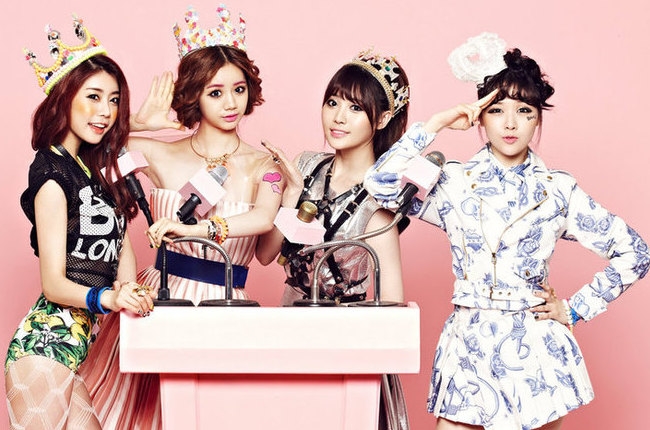
Following Park’s inauguration, the South Korean entertainment industry sought to capitalize on the zeitgeist of "female leadership." On June 24, 2013, the four-member girl group Girl’s Day—consisting of Sojin, Yura, Minah, and Hyeri—released their repackaged first album with the title track "Female President."
The release followed a period of transition for the group. Originally debuting in 2010 with a "cute" concept, Girl’s Day had shifted toward a more mature and "sexy" image with their previous hit "Expectation." "Female President" was designed to solidify this new identity while ostensibly celebrating the newfound political power of women. The song’s promotional cycle included a high-profile showcase where the members performed in front of the press, explicitly linking the song’s title to the contemporary political climate.
Socio-Economic Data and the Gender Gap in 2013
To understand the criticism leveled against the song’s message, it is necessary to examine the socio-economic landscape for women in South Korea during the early years of the Park administration. In 2013, South Korea’s gender wage gap stood at approximately 36.3%, the highest among all OECD nations. This meant that for every dollar earned by a South Korean man, a woman earned roughly 64 cents.
Furthermore, the World Economic Forum’s Global Gender Gap Report in 2013 ranked South Korea 111th out of 136 countries, placing it significantly lower than many other developed economies. The report highlighted particularly low scores in "Economic Participation and Opportunity." While South Korean women had high levels of educational attainment, often outperforming men in university entrance rates, this did not translate into corporate leadership. In 2013, women held fewer than 2% of board seats in South Korea’s top 100 companies.
Additionally, legal restrictions on reproductive rights remained a significant point of contention. In 2013, abortion was illegal in South Korea except in cases where the mother’s health was in peril, the pregnancy resulted from rape or incest, or there were severe hereditary disorders. This legal framework was often cited by activists as a primary example of the state’s control over women’s bodies, a reality that stood in stark contrast to the symbolic empowerment of a female presidency.
Analysis of the Lyrical and Visual Narrative
Critics have noted that despite its provocative title, "Female President" does not address the aforementioned systemic issues. Instead, the lyrics focus almost exclusively on interpersonal romantic dynamics. The central "empowerment" message of the song is the suggestion that because the country has a female president, a woman should feel emboldened to initiate a kiss or express romantic interest first, rather than waiting for a man to act.
The chorus includes the lines: "The president of our country is now a woman / So why are you being so hesitant? / Why is it a problem if a girl kisses first?"
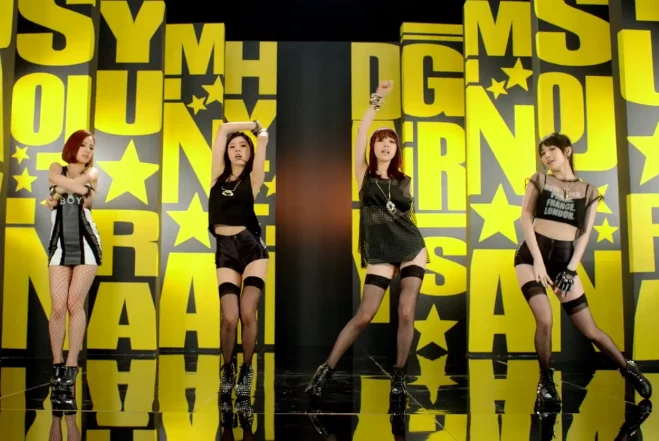
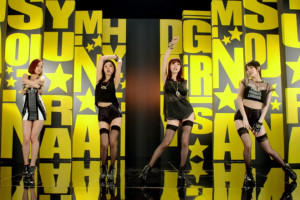
From a sociological perspective, this narrative choice has been analyzed as a form of "commercialized feminism." By framing political progress as a justification for minor shifts in dating etiquette, the song arguably trivializes the broader struggle for gender equality. Furthermore, the music video employs the "sexy" concept prevalent in K-pop during the early 2010s. It features choreography and costuming designed to appeal to the male gaze, including high-slit skirts and body-hugging outfits. This creates a paradox where the "empowerment" being sold is packaged in a way that adheres to traditional patriarchal standards of female beauty and desirability.
The video also includes a subplot involving member Minah and a suit-wearing, androgynous version of Hyeri. While some viewers interpreted this as a nod toward gender fluidity or a subversion of heteronormative tropes, the scenes were ultimately depicted through a lens of "aegyo" (a Korean term for acting cute or charming), which many critics argue reinforces a subservient or infantile image of women rather than a powerful one.
Public and Critical Reception
The reception of "Female President" was mixed. Commercially, the song was a success, reaching number five on the Gaon Digital Chart and earning the group a win on the music program Inkigayo. For the group’s management, Dream Tea Entertainment, the strategy of using a topical political headline to generate buzz was effective.
However, the response from social commentators and feminist scholars was more skeptical. The disconnect between the song’s title and its content was frequently highlighted in editorials. Critics argued that the song co-opted the language of progress to sell a product that remained firmly rooted in the status quo.
"The song uses the image of the president to tell women they can be ‘bold’ in love, but it ignores the fact that being ‘bold’ in the workplace or in the legal system remains incredibly difficult for the average Korean woman," noted one cultural critic during the song’s promotional run.
Broader Impact and Implications
The "Female President" era of Girl’s Day serves as a case study in how K-pop interacts with national identity and social movements. It reflects a broader trend in the industry where complex social issues are distilled into catchy hooks and visual spectacles.
In the years following the song’s release, the political and social landscape of South Korea underwent dramatic shifts. Park Geun-hye’s presidency, which began with the promise of "gender-sensitive" policies, ended in 2017 with her impeachment and removal from office following a massive corruption scandal. Her downfall led to a resurgence of grassroots feminist movements in South Korea, such as the "Escape the Corset" movement and the "Me Too" movement, which were far more confrontational and policy-oriented than the symbolic empowerment suggested by the 2013 pop hit.
Furthermore, the legal landscape has since evolved. In 2019, South Korea’s Constitutional Court ruled that the ban on abortion was unconstitutional, a landmark victory for women’s rights that many activists felt was more meaningful than the election of a female president from a conservative dynasty.
In conclusion, while Girl’s Day’s "Female President" remains a notable artifact of 2013 K-pop, it is often remembered more for what it omitted than what it included. By linking the highest office in the land to the simple act of a woman initiating a kiss, the song highlighted the gap between political representation and social liberation. It remains a definitive example of how cultural products can simultaneously celebrate and undermine the progress they claim to represent. For observers of South Korean society, the song stands as a reminder that true empowerment requires more than a change in leadership or a catchy chorus; it requires a fundamental restructuring of the economic and legal barriers that continue to define the female experience.