The global music landscape underwent a significant shift on November 3, 2013, as the South Korean girl group Girls’ Generation, managed by SM Entertainment, was announced as the winner of the Video of the Year award at the first-ever YouTube Music Awards (YTMA). Held at Pier 36 in New York City and streamed live to millions of viewers worldwide, the event recognized the nine-member ensemble for their 2013 hit "I Got A Boy." The win was particularly notable as the group surpassed major international superstars, including Justin Bieber, Lady Gaga, Miley Cyrus, Psy, and Demi Lovato. Tiffany Hwang, a member of the group, accepted the award in person, expressing gratitude to the fans—collectively known as SONE—and acknowledging the platform YouTube provided for K-pop to transcend domestic borders.
The victory serves as a definitive marker for the "Korean Wave" or Hallyu, demonstrating that the success of South Korean artists in Western markets is no longer restricted to viral anomalies like Psy’s "Gangnam Style." Instead, it reflects a deeply entrenched, highly organized digital infrastructure supported by a dedicated global fan base. The YouTube Music Awards’ criteria for Video of the Year were predicated on social media engagement, specifically focusing on the number of times a video was shared across platforms like Facebook, Twitter, and Google+. This metric favored artists with the most mobilized and digitally active communities, a category in which K-pop fans have historically excelled.
The Evolution of the YouTube Music Awards and Selection Criteria
The YouTube Music Awards were established to honor the artists and videos that turned the video-sharing site into a primary destination for music discovery. Unlike traditional award shows like the Grammys or the MTV Video Music Awards, which often rely on academy votes or a combination of sales and airplay, the YTMAs were designed to reflect digital reality. The nominees were selected based on YouTube data from the previous year, including total views, likes, comments, and subscriptions.
For the Video of the Year category, the winner was determined through a "share-to-vote" system. Fans were required to share specific promotional videos from the YouTube Music Awards channel to their own social media feeds. This mechanism was intended to measure "virality" and "advocacy" rather than just passive consumption. For Girls’ Generation, this meant that their victory was not just a result of the 80 million views "I Got A Boy" had accumulated at the time, but rather the sheer volume of organized sharing initiated by their followers during the voting period.
A Chronology of Girls’ Generation’s Path to Global Recognition
To understand the magnitude of this win, one must examine the trajectory of Girls’ Generation since their debut in 2007. Initially gaining domestic fame with hits like "Into the New World," the group achieved "national girl group" status in South Korea with the 2009 megahit "Gee." This track held the record for the longest-running number-one song on the Korean music program Music Bank for nine consecutive weeks and was a catalyst for their expansion into Japan and other Asian markets.
By 2011, SM Entertainment began eyeing the North American market more aggressively. The group released "The Boys," which featured an English version and was distributed in the United States via Interscope Records. They made history as the first Korean musical act to perform on major U.S. talk shows, including "Late Show with David Letterman" and "Live! with Kelly."
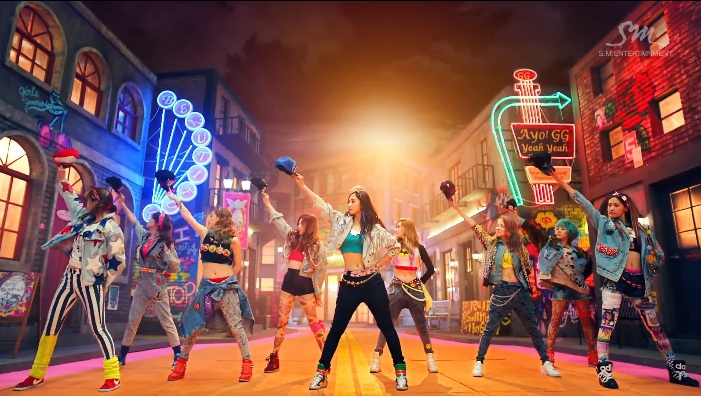
The release of "I Got A Boy" on January 1, 2013, represented a stylistic departure for the group. The song was a maximalist, genre-bending experiment that fused bubblegum pop, hip-hop, and dubstep. While it initially polarized some listeners due to its unconventional structure, its high-energy music video—characterized by vibrant street-style fashion and intricate choreography—became a staple of the YouTube era. The Video of the Year win at the YTMAs acted as the culmination of a six-year journey toward international legitimacy.
Systematic Fandom Mobilization: The SONE Strategy
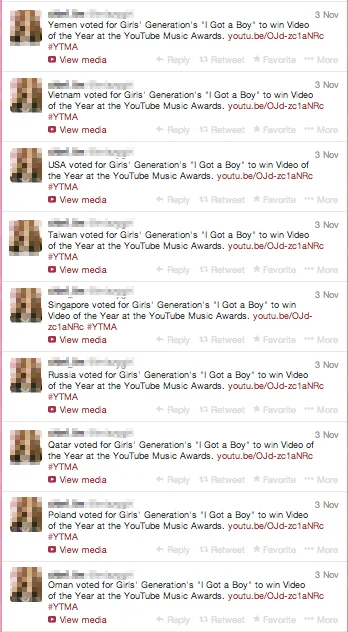
The primary driver behind the YTMA victory was the unprecedented level of organization within the Girls’ Generation fandom. While many Western pop fans engage in voting, K-pop fandoms operate with a level of discipline and strategic planning that resembles a political campaign. Observations from social media platforms during the voting window revealed a multi-tiered approach to securing the win.
Fan communities organized "relay sessions," where voting responsibilities were handed off between different geographical regions based on time zones. This ensured that the voting momentum never slowed down over a 24-hour cycle. When fans in Asia went to sleep, fans in Europe and the Americas took over. Furthermore, the use of multiple accounts and identities was a common tactic discussed in fan forums to maximize the impact per person. Reports indicated that fans were creating instructional guides in multiple languages to streamline the sharing process, ensuring that even casual listeners could contribute to the tally.
This "power voting" phenomenon highlights a shift in how popularity is measured in the digital age. The YouTube algorithm, designed to reward organic sharing, was effectively "optimized" by a concentrated minority of super-users. While this led to questions regarding the authenticity of the "worldwide" appeal, it nonetheless proved that Girls’ Generation possessed a level of consumer loyalty that traditional Western artists struggled to match in the digital sphere.
Industry Data and Comparative Metrics
The data surrounding the 2013 YouTube Music Awards provides insight into the changing tides of the music industry. At the time of the awards, the nominees for Video of the Year represented the pinnacle of digital reach:
- Girls’ Generation – "I Got A Boy"
- Miley Cyrus – "We Can’t Stop"
- Justin Bieber (feat. Nicki Minaj) – "Beauty and a Beat"
- Lady Gaga – "Applause"
- Psy – "Gentleman"
- Demi Lovato – "Heart Attack"
- Selena Gomez – "Come & Get It"
- One Direction – "Best Song Ever"
- Macklem0re & Ryan Lewis – "Same Love"
- Epic Rap Battles of History – "Barack Obama vs. Mitt Romney"
Despite "I Got A Boy" having fewer total views than Psy’s "Gentleman" or Justin Bieber’s "Beauty and a Beat" at the time of the ceremony, the "share" metric leveled the playing field. This suggests that while Western artists may have higher "passive" reach through radio and general public recognition, K-pop artists possess higher "active" engagement. For a platform like YouTube, which thrives on user interaction and data harvesting, active engagement is a more valuable currency than passive viewership.
Reactions and the "Cultural Friction" of the Win
The announcement of Girls’ Generation as the winner was met with a mixture of celebration and controversy. In the immediate aftermath, social media was flooded with reactions from confused Western music fans, many of whom were unfamiliar with the group. This led to a brief but intense period of "cultural friction," where some fans of the losing nominees expressed their frustration through dismissive or xenophobic comments, questioning how an "unknown" group could beat established American stars.
Conversely, the K-pop community responded with a defensive and proud stance, highlighting the group’s years of hard work and the global nature of modern music. Industry analysts noted that the backlash was a symptom of a broader disconnect between the traditional US-centric music industry and the decentralized, internet-driven global market. The win forced the mainstream media to acknowledge that "global" popularity no longer required a primary base in the United States or the United Kingdom.
Broader Impact and Implications for the Future of K-Pop
The long-term implications of Girls’ Generation’s YTMA win are twofold. First, it validated the "Idol" system’s focus on visual storytelling and digital-first marketing. SM Entertainment’s ability to produce a product that resonated across language barriers proved that high production value and performance-oriented content are universal languages on the internet.
Second, the win raised questions about the future of K-pop’s expansion into the American market. While the victory confirmed a "worldwide" presence, it did not immediately translate into sustained US radio play or chart dominance for the group. This underscored the difference between "digital fandom power" and "mainstream market penetration." However, it paved the way for future groups like BTS and BLACKPINK, who would later use similar digital-first strategies to achieve both fan-driven accolades and commercial success on the Billboard charts.
The relationship between K-pop labels and American distributors, such as the partnership between SM Entertainment and Interscope, was also re-evaluated. The win demonstrated that there was a massive, untapped audience for K-pop in the West, but capturing that audience required more than just digital votes; it required a nuanced approach to Western media cycles and touring.
Conclusion: A Milestone in Digital Music History
The 2013 YouTube Music Awards will be remembered as the moment the digital curtain was pulled back to reveal the true scale of the K-pop phenomenon. Girls’ Generation’s victory for "I Got A Boy" was not a fluke, but the result of a perfectly executed synergy between a high-quality creative product and a sophisticated, globalized fan base.
As the music industry continues to move toward a model where data and engagement are the primary metrics of success, the strategies pioneered by SONEs and SM Entertainment have become the blueprint for modern stardom. While the "internal brouhaha" and the debates over voting systems may fade, the fact remains that on one of the world’s largest stages, nine women from Seoul stood at the center of the spotlight, proving that the future of music is increasingly borderless, digital, and undeniably Korean.