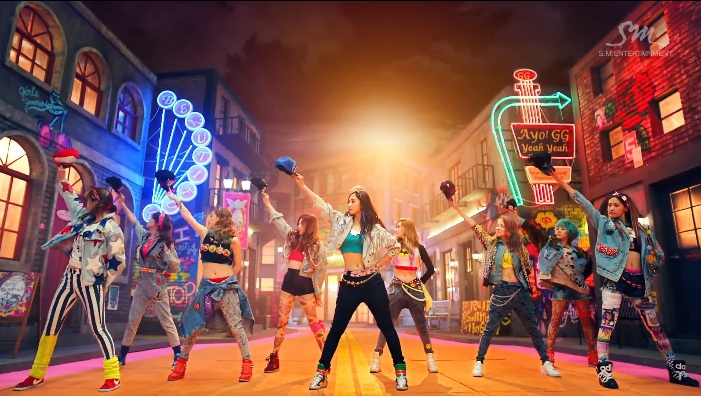
The global music landscape witnessed a significant shift in late 2013 when the South Korean girl group Girls’ Generation, also known as SNSD, secured the "Video of the Year" honor at the inaugural YouTube Music Awards (YTMA). Held at Pier 36 in New York City, the event was designed to celebrate the digital era’s most influential artists and videos based on engagement metrics rather than traditional industry gatekeeping. Girls’ Generation’s victory for their genre-bending single "I Got a Boy" not only marked a milestone for the group but also signaled the definitive arrival of K-pop in the international mainstream. By surpassing global heavyweights such as Justin Bieber, Lady Gaga, Miley Cyrus, and Selena Gomez, the nine-member ensemble from SM Entertainment demonstrated the unprecedented power of organized digital fandoms, sparking a broader conversation about the evolution of music consumption and the globalization of pop culture.
The Mechanics of a Digital Victory
The YouTube Music Awards were structured to reflect the platform’s unique ecosystem, prioritizing "social sharing" as the primary metric for success. Unlike the Grammy Awards, which rely on a peer-voting academy, or the Billboard Music Awards, which factor in sales and radio airplay, the YTMAs sought to measure the velocity of a video’s viral spread. To win "Video of the Year," a nominee’s video had to be shared across social media platforms more frequently and rapidly than its competitors during the voting period.
This criteria played directly into the strengths of K-pop fandoms, which are characterized by a high degree of digital literacy and organizational discipline. For "I Got a Boy," the victory was less a result of casual viewership and more a product of a calculated, global campaign. Fans, primarily the group’s official fandom known as "SONE," leveraged the platform’s rules to maximize impact. Data analyzed following the event suggested that while Western artists often possessed higher raw view counts, the intensity of engagement—measured by shares per unique user—was significantly higher for Girls’ Generation.
A Chronology of the "I Got a Boy" Phenomenon
The journey to the YouTube Music Awards began on January 1, 2013, with the release of "I Got a Boy." The track was a departure from the group’s previous bubblegum pop and electro-pop hits, featuring a complex, multi-sectional structure that combined elements of hip-hop, rock, and dubstep. This experimental sound was accompanied by a high-budget music video that showcased intricate choreography and vibrant, street-style fashion, designed specifically to capture the attention of a global audience.
Upon its release, the music video achieved 10 million views in just 55 hours, a record-breaking feat at the time. Throughout 2013, the song remained a staple of digital discourse, bolstered by SM Entertainment’s aggressive international marketing strategy. By the time nominations for the YTMAs were announced in October 2013, "I Got a Boy" had already established itself as a digital juggernaut. On November 3, 2013, member Tiffany Young accepted the award on behalf of the group, delivering a speech in English that thanked the global fan base for their tireless support.
Systematic Fandom Mobilization: The Relay Strategy
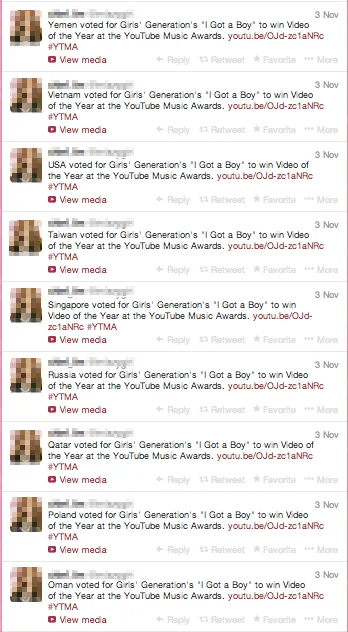
The victory was the culmination of a sophisticated effort that the source material identifies as "power voting." K-pop fandoms have long been recognized for their ability to organize "streaming parties" and "voting relays," and the YTMA campaign was a prime example of this phenomenon. Reports from social media monitoring during the voting window revealed that fans established a "relay" system to ensure constant activity.
Under this system, fans in specific time zones would oversee voting during their peak waking hours before "passing the baton" to fans in the next region. This 24-hour cycle ensured that the momentum for "I Got a Boy" never stalled. Furthermore, fans utilized various digital identities to bypass limitations on voting frequency. Observations on platforms like Twitter showed accounts ranging from parody profiles to international supporters in regions like Zimbabwe and various European nations casting votes in a unified front. This level of systematic effort raised questions about the nature of "popularity" in the digital age—whether it reflects a broad consensus of the general public or the intense dedication of a focused minority.
Comparative Context: From Psy to Girls’ Generation
The success of Girls’ Generation at the YTMAs is often compared to the viral explosion of Psy’s "Gangnam Style" in 2012. However, industry analysts note a distinct difference between the two events. Psy’s success was largely organic and driven by a "meme" culture that transcended traditional fandom boundaries. In contrast, Girls’ Generation’s win represented the institutional strength of the "Idol" system.
While Psy introduced the world to the visual spectacle of K-pop, Girls’ Generation proved that the genre had a sustainable, highly engaged audience capable of influencing major Western awards. This transition from "viral curiosity" to "fandom-driven powerhouse" marked a turning point for SM Entertainment and other Korean labels, confirming that the "Hallyu Wave" (Korean Wave) was not a temporary fad but a structural shift in the global music industry.
Western Backlash and Cultural Friction
The announcement of Girls’ Generation as the winner was met with significant friction from Western audiences, particularly the fandoms of established American pop stars. Social media platforms were flooded with "Who is Girls’ Generation?" queries, often accompanied by xenophobic rhetoric or dismissive comments regarding the group’s origins. The tension highlighted a disconnect between the traditional Western music market and the rapidly expanding global digital landscape.
Critics of the win argued that the YouTube Music Awards’ reliance on social sharing allowed for "gaming the system," suggesting that the results did not accurately reflect the musical preferences of the average listener. Conversely, supporters of the group pointed out that the rules were applied equally to all nominees. They argued that the ability of a South Korean group to mobilize a global audience to out-vote the world’s biggest stars was, in itself, a definitive indicator of "worldwide popularity" and "video of the year" status.
Strategic Implications for SM Entertainment and the US Market
For SM Entertainment, the YTMA win was a validation of their long-term international strategy. The group had previously made inroads into the United States, including a 2012 appearance on The Late Show with David Letterman and a partnership with Interscope Records for the English-language release of "The Boys." The YouTube award provided the necessary leverage to argue for the group’s viability in the North American market.
However, the win also presented a strategic dilemma. Despite the digital triumph, the challenge of breaking into the heavily gatekept US radio market remained. The "I Got a Boy" victory demonstrated that while K-pop could dominate digital metrics, translating that into traditional Western superstardom required a different set of tools, including localized promotions and perhaps a shift in musical styling. In the years following the 2013 YTMAs, the industry saw an increase in collaborations between K-pop artists and Western producers, as well as more frequent North American tour circuits.
Analysis of the Digital Award Era
The 2013 YouTube Music Awards served as a case study for the future of entertainment accolades. It highlighted the shift from "passive consumption" to "active participation." In this new era, the value of a music video is measured not just by how many people see it, but by how many people are willing to advocate for it.
The Girls’ Generation win underscored several key realities of the modern music business:
- Digital Sovereignty: Platforms like YouTube have decentralized the power of traditional media, allowing international artists to compete on a level playing field.
- Fandom as Infrastructure: A dedicated, organized fandom is a more potent asset in the digital age than a massive but disengaged general audience.
- The Globalization of Taste: The "mainstream" is no longer defined solely by Western trends; it is a collection of global niches that can, when mobilized, eclipse traditional pop icons.
Legacy of the 2013 YouTube Music Awards
In retrospect, the victory of Girls’ Generation at the YTMAs was a precursor to the eventual global dominance of groups like BTS and Blackpink. It proved that the K-pop model of high-quality visual production combined with intensive fan engagement was a winning formula for the internet age. While the controversy surrounding "power voting" continues to be a topic of debate in award season discussions, the factual reality remains that Girls’ Generation achieved what was once thought impossible for a non-English speaking act.
The group’s longevity and the marketing prowess of SM Entertainment created a foundation that allowed them to withstand the scrutiny of the Western press. By securing the "Video of the Year" title, Girls’ Generation did more than just take home a trophy; they forced the global music industry to acknowledge a new world order where the coordinates of pop stardom are no longer fixed in Hollywood or New York, but are distributed across a vast, interconnected digital network. As the industry continues to evolve, the 2013 YTMAs remain a pivotal moment where the "vocal minority" of a global fandom became the "loudest voice" in the room, forever changing the criteria for international success.