
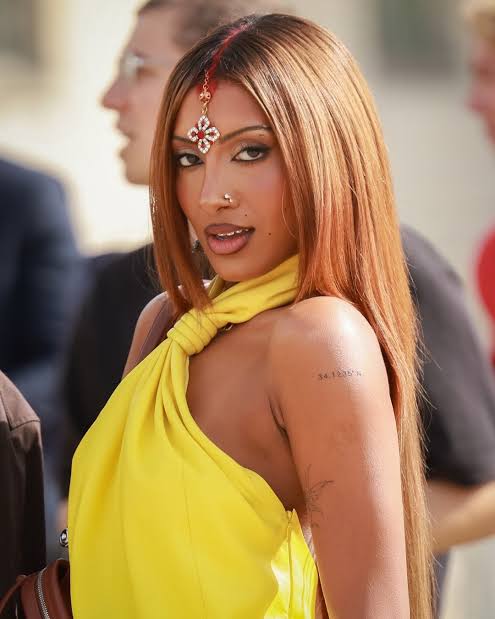
The intersection of global pop culture and traditional heritage took center stage on October 2, 2026, as Lara, a prominent member of the international girl group KATSEYE, attended the Loewe Spring/Summer 2027 show during Paris Fashion Week. While the event was intended to showcase the latest designs from Creative Director Jonathan Anderson, the conversation quickly shifted from the runway to the styling choices of the Indian-American singer. Lara, accompanied by her groupmate Megan, appeared at the high-profile event wearing a distinct red vermilion mark, known as "sindoor" or "kumkum," along the central parting of her hair. This choice ignited an immediate and multifaceted debate across social media platforms, touching upon themes of religious tradition, feminist theory, cultural gatekeeping, and the politics of representation for South Asian women in the global eye.
The Event and the Styling Choice
Paris Fashion Week remains the most significant fixture in the global fashion calendar, and the Loewe show is traditionally one of its most anticipated events. KATSEYE, the first global girl group formed through a joint venture between HYBE and Geffen Records, has seen its members become rising icons in both the music and fashion industries. Lara’s appearance was marked by a sophisticated blend of contemporary high fashion and a bold cultural statement.
The "sindoor" is a traditional red or orange-red cosmetic powder worn by Hindu women. Historically and religiously, it is applied in the parting of the hair (the "maang") to signify a woman’s married status and to symbolize the longevity of her husband’s life. However, Lara, who is not married, applied the mark as a deliberate aesthetic and cultural homage. In a brief interview conducted during the event, Lara clarified that her look was inspired by the legendary Bollywood actress Rekha, a figure synonymous with timeless elegance and the subversion of social expectations in India.

The Chronology of the Controversy
The timeline of the online "storm" began almost immediately after the first high-definition press photos of Lara and Megan were uploaded to X (formerly Twitter) and Instagram.
- Initial Reaction (October 2, Morning): Fashion enthusiasts and KATSEYE fans (known as Eyekons) praised the look for its boldness and the way it complemented the Loewe ensemble.
- The "Marital Status" Query (October 2, Midday): As the images circulated within the Indian diaspora and among residents in India, users began questioning the use of the sindoor. The primary question—"Is she married?"—quickly transitioned into accusations that she was using a sacred marital symbol as a "cheap accessory."
- Lara’s Clarification (October 2, Afternoon): An interview clip was released where Lara explicitly cited Rekha as her inspiration, noting that she was wearing "red kumkum" on her forehead as a tribute to the actress’s iconic style.
- The Feminist and Traditionalist Split (October 2, Evening): The clarification did not quell the debate but rather redirected it. Critics began arguing over whether it is possible to "reclaim" a symbol rooted in patriarchy, while traditionalists continued to argue that the religious sanctity of the powder was being diluted by secular fashion usage.
- The Colorism Discourse (October 3): By the following day, a significant portion of the conversation shifted toward the scrutiny Lara faces compared to other celebrities. Fans argued that as a dark-skinned South Asian woman, Lara is subjected to a higher standard of "cultural purity" than her lighter-skinned or non-Indian counterparts.
Understanding the Inspiration: The Rekha Legacy
To understand why Lara’s choice was so polarizing, one must look at the figure of Rekha. An icon of Indian cinema, Rekha’s personal life and fashion choices have been the subject of public fascination for decades. In 1980, she famously appeared at a high-profile wedding wearing sindoor and a mangalsutra (a sacred wedding necklace), despite not being publicly married to anyone at the time.
For decades, Rekha has continued to wear sindoor at public events, even as a widow. In traditional Hindu customs, widows are often socially barred from wearing vibrant colors, jewelry, or sindoor. By continuing to wear it, Rekha transformed the item from a signifier of a woman’s relationship with a man into a symbol of her own agency and aesthetic identity. Lara’s decision to cite Rekha suggests an attempt to align herself with this brand of subversive South Asian womanhood—one that respects the aesthetic of the culture while challenging the rigid rules governing who is allowed to wear it.
Perspectives from the Public Debate
The online discourse regarding Lara’s appearance can be categorized into four primary viewpoints:

The Traditionalist Critique
A segment of the audience viewed the use of sindoor by an unmarried woman at a secular fashion event as a trivialization of Hindu customs. These critics argue that certain symbols carry a weight that transcends fashion. From this perspective, stripping the sindoor of its religious and marital meaning is seen as "cherry-picking" traditions to create a "performative aesthetic" for a Western audience.
The Feminist Conflict
Perhaps the most complex layer of the debate involves South Asian feminists. One group argues that sindoor is an inherently patriarchal symbol, historically used to "mark" women as the property of their husbands. They contend that an unmarried woman wearing it does not "smash the patriarchy" but rather reinforces a regressive symbol. Conversely, other feminists argue that the most "progressive" stance is to allow women to choose how they interact with their heritage. They suggest that by wearing sindoor as a fashion choice, Lara is helping to decouple the ornament from its mandatory patriarchal origins, thereby reducing its power as a tool of social control.
The "Culture Appropriation" Paradox
Unusually, some critics accused Lara of "appropriating her own culture." This argument often stems from the tension between the South Asian diaspora (NRIs) and those living in India. Some residents of India feel that members of the diaspora use cultural symbols to appear "exotic" in the West without having to live through the social pressures or expectations associated with those symbols in a domestic Indian context.
The Defense Against Colorism
Many of Lara’s supporters pointed out that the vitriol directed toward her often contains undertones of colorism and misogyny. They noted that K-pop idols or Western celebrities who have used South Asian symbols (like the bindi or henna) as "boho-chic" trends often face less scrutiny than a woman of actual Indian descent. These defenders argue that Lara is being "gatekept" by her own community, who are uncomfortable seeing a dark-skinned woman represent the culture on a global stage like Paris Fashion Week.
Broader Implications for Global Representation
Lara’s appearance at the Loewe show is a microcosm of the challenges facing the new generation of "global" idols. As groups like KATSEYE aim to appeal to a worldwide audience, their members frequently navigate multiple cultural identities simultaneously. For Lara, being a representative of a major K-pop-style group while also being an Indian-American woman means that her fashion choices are never "just fashion." They are political statements, whether intended or not.
The incident also highlights the evolving nature of South Asian representation in the luxury fashion industry. In recent years, brands like Dior and Loewe have made concerted efforts to engage with the Indian market and its diaspora. However, as cultural symbols move from the domestic/religious sphere to the international runway, friction is inevitable.
Conclusion
The debate surrounding Lara’s use of sindoor at Paris Fashion Week serves as a reminder that the globalization of culture is a messy, ongoing process. While some see her choice as a disrespectful "performance," others see it as a powerful reclamation of an aesthetic that has long been used to categorize and restrict women.
By invoking Rekha, Lara signaled that she is aware of the historical weight of her choices. Whether this act was one of "cultural dilution" or "cultural evolution" remains a matter of perspective. However, what is undeniable is that Lara has succeeded in forcing a global audience to engage with South Asian traditions in a way that goes beyond the surface level, sparking a necessary—if heated—conversation about who owns a culture’s symbols and who is allowed to redefine them for the modern age. As KATSEYE continues to rise in global prominence, the actions of its members will likely continue to serve as a lightning rod for discussions on identity, heritage, and the future of global stardom.